Limb SD connects property owners with licensed and insured independent tree professionals across San Diego County. Limb SD holds no trade licenses and performs no tree work. The customer hires and pays the matched professional directly.
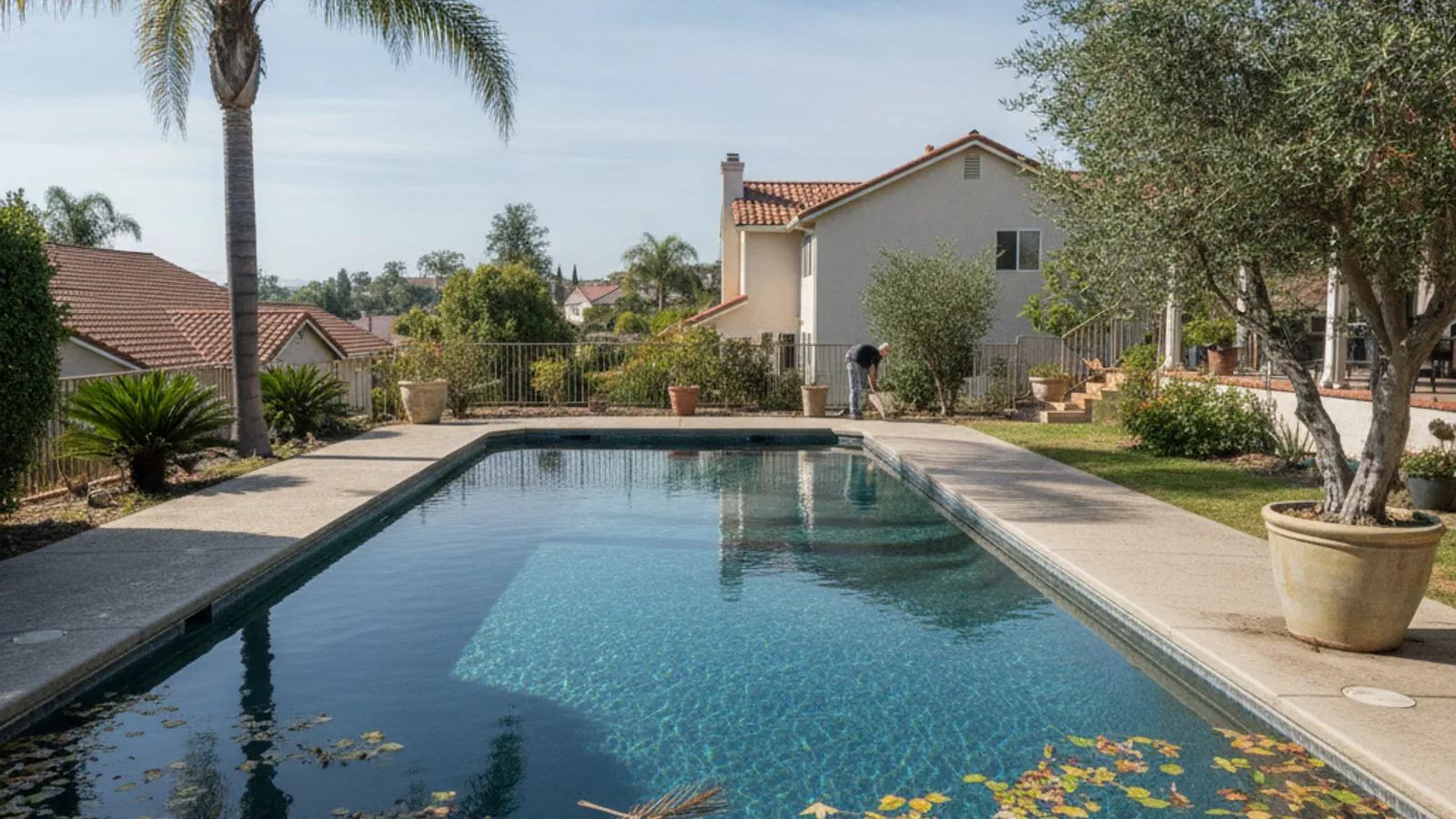
The best poolside tree is one that drops little, stays out of the pool’s shade, and keeps its roots shallow and non-aggressive. No tree is litter-free. The San Diego Horticultural Society’s newsletter puts it plainly: all trees have some debris. This guide covers what to look for, species that fit and species people regret, and your options if a tree is already causing pool problems.
What makes a tree a poor choice next to a pool?
Four traits do most of the damage: what falls, how often it falls, how thorny it is, and where the roots run.
The San Diego Horticultural Society says trees close to pools need to be “clean, non-drippy plants with leaves that hang on for a long time.” Fine, constant litter fills a skimmer. Fruit and flowers stain decking. Spines turn a barefoot walk into a problem.
Roots matter too. UC IPM says most roots are near the soil surface and many extend much farther than the tree canopy spread. So the edge of the canopy is not the edge of the root zone.
Shade is the fourth. The same Horticultural Society piece says Italian cypress works as a pool screen if it’s “planted on the north side of the pool so they don’t shade it.” Which side the tree sits on changes how much sun the water gets.
How close can a tree be to a pool?
No single distance fits every tree, so the answer comes from the species and the site. Ask your pool builder and a tree professional. The mature size of the tree matters more than its size at the nursery.
Two facts help you judge. Roots reach past the canopy, as noted above. And a new pool near a tree you already own is a root question: UC IPM advises that you avoid crushing or cutting roots, “especially those larger than about 2 inches in diameter” and consult an arborist certified by the International Society of Arboriculture before construction near mature trees. Raise this before the excavator arrives, not after.
Which trees do San Diego sources recommend near pools?
The first five come from San Diego Horticultural Society writers. The olive note comes from UC IPM’s olive page, which isn’t pool-specific. The trait that matters is listed for each.
| Tree | Trait that matters |
|---|---|
| Mediterranean fan palm (Chamaerops humilis) | Clean, compact, clumping |
| Indian hawthorn (Rhaphiolepis) | Called one of the cleanest small patio trees, pruned once a year after bloom |
| Avocado | Very shallow roots, unlikely to disturb pool plumbing |
| Citrus | Shiny evergreen leaves and colorful fruit |
| Italian cypress | A privacy screen, best on the north side |
| ’Swan Hill’ olive | Noted for little fruit and pollen |
A few cautions apply. Fruit trees trade one kind of litter for another, so ask where the fruit will land. Olive pollen is highly allergenic, and ‘Swan Hill’ is the cultivar UC IPM names for little pollen. Avocado’s shallow roots help the plumbing but say nothing about leaf drop. For cypress spacing and fence setbacks, see the privacy tree guide.
Which trees do people regret planting by a pool?
Fruiting olive. UC IPM says fruiting types drop fruit, which will stain pavement and patios. A pool deck is pavement.
Jacaranda. The University of Florida’s extension service (UF/IFAS) describes jacaranda as a tree that drops both leaves and flowers yearly and calls it a poor choice for pool-side plantings. That’s a Florida description, not a San Diego finding, so watch how your own tree drops before you plan around it. Our jacaranda guide covers the San Diego side.
Eucalyptus. A 1971 to 1978 University of California evaluation of 92 eucalyptus species planted at a field station in San Jose observed litter but didn’t measure it. That litter was made of flower caps, flowers, fruit, twigs, and leaves. Observers there judged summer litter more objectionable, as it was more visible, trashy, and a fire hazard. That’s a Northern California station, and species vary, so see the eucalyptus guide.
Ficus. Root damage to paving isn’t certain, but it’s a real question near a deck. Read the ficus guide before planting one there.
Spiny palms. The Horticultural Society notes that several palms suit pools, but many are armed and need to be set back from where people walk.
What about palms near a pool?
The Horticultural Society says several palm trees are good near swimming pools, but the type matters. Washingtonia, the group that includes the Mexican fan palm, is the one to think hard about.
A palm study by UC Cooperative Extension’s Donald Hodel and coauthors says that when Washingtonia palms are heavily laden, falling fruits pose a nuisance and hazard, and fruit stalks and leaves are typically removed in annual pruning. The same paper says that in coastal southern California the seeds germinate readily and the plants can become invasive. Cal-IPC adds that dead fronds can create a fire hazard.
If you already have one, read the Mexican fan palm trim, skin, or remove guide. Dead-frond work on a tall palm is a job for a crew, not a ladder.
What if a tree is already causing pool problems?
Start by naming the problem. The fix differs for each.
Litter and clogged skimmers. Pruning can raise or thin the canopy over the water. UC IPM says to avoid topping, the drastic heading of large branches, because it encourages weakly attached branches that are susceptible to wind breakage. It also says not to overprune, to avoid wounds and sunburn. Ask the pro you hire how much canopy stays and where the cuts go. See tree trimming.
Roots lifting the deck or coping. Cutting roots can hurt the tree. UC IPM’s advice on cutting roots larger than about 2 inches, above, applies here. A vertical barrier is not a guaranteed fix either. The root barrier guide covers what the studies found. Have an arborist look at the roots before anyone digs.
Shade or constant mess you can’t fix by pruning. Removal may be the cleaner answer, with a better-matched tree in a better spot. Quotes depend on access, size, and the pool’s proximity. A pool, fence, or deck near the tree may call for rope rigging. See tree removal and ask each pro how they’d protect the pool.
A tree near your house. If the home is in a City of San Diego Very High Fire Severity Zone, the next section applies.
Does fire clearance change which trees you keep?
It can, if the home sits in one of the City of San Diego’s Very High Fire Severity Zones and the tree is close to a structure. For trees in Zone 0, the first 5 feet around a building, the City says healthy branches must be kept at least five feet from roofs and exterior walls. At maturity, the canopy must be at least 10 feet from roofs and other structures.
Timing differs by structure. The City says Zone 0 is required for new structures in those zones built after February 28, 2026, and that existing owners should aim to meet Zone 0 guidelines by February 2027. The City’s Zone 0 guidelines for existing structures, revised April 22, 2026, apply to existing structures beginning February 28, 2027. The same document says property owners are not required to take any action now. Under those guidelines, existing trees within 5 feet of a structure may remain in place if conditions apply. One condition is that leaf litter and debris beneath the tree be regularly removed. Under an approved compliance plan, removal may be required if the tree presents an unreasonable fire risk due to species, condition, or fuel accumulation.
These guidelines cover structures in the City of San Diego’s Very High Fire Hazard Severity Zones, and they’re subject to change at the discretion of the City’s Fire Code Official. Other cities and unincorporated areas follow their own fire authority. Call the Community Risk Reduction Division at (619) 533-4388 for City addresses, and read our defensible space guide to find your authority.
Frequently asked questions
What is the best tree to plant next to a pool in San Diego?
No tree is perfect. San Diego Horticultural Society writers favor Mediterranean fan palm, Indian hawthorn, avocado, and citrus. UC IPM notes the ‘Swan Hill’ olive has little fruit and pollen.
Do avocado roots damage pools?
The San Diego Horticultural Society says avocados have very shallow roots and are highly unlikely to disturb pool plumbing. Leaf and fruit drop are separate questions.
Is jacaranda a good tree near a pool?
The University of Florida’s extension service calls it a poor choice for pool-side plantings because it drops leaves and flowers yearly. That’s a Florida description, so confirm how it behaves in your yard with a tree professional.
How far should a tree be from a pool?
It depends on the species’ mature size and root habit. Ask your pool builder and an arborist. UC IPM notes that roots often extend beyond the canopy.
Can I cut roots that are lifting my pool deck?
Sometimes, but cutting roots can harm the tree. UC IPM advises avoiding cuts to roots larger than about 2 inches and consulting an ISA-certified arborist.
Are palm trees safe near a pool?
Some are. Others drop fruit and dead fronds, or have spines. Match the palm to the space and plan on regular cleanup.
The short version
Choose a clean, shallow-rooted tree and plant it where its mature canopy won’t hang over the water. For a tree you already have, name the problem first: litter, roots, shade, or fire clearance. Then ask a pro about pruning before removal.
When to call a tree professional
Call when a tree drops debris into the pool, when roots are lifting the deck, or before a new pool goes in near a mature tree. Call (858) 400-4587 and Limb SD will connect you with a licensed local tree professional.