Limb SD connects property owners with licensed and insured independent tree professionals across San Diego County. Limb SD holds no trade licenses and performs no tree work. The customer hires and pays the matched professional directly.
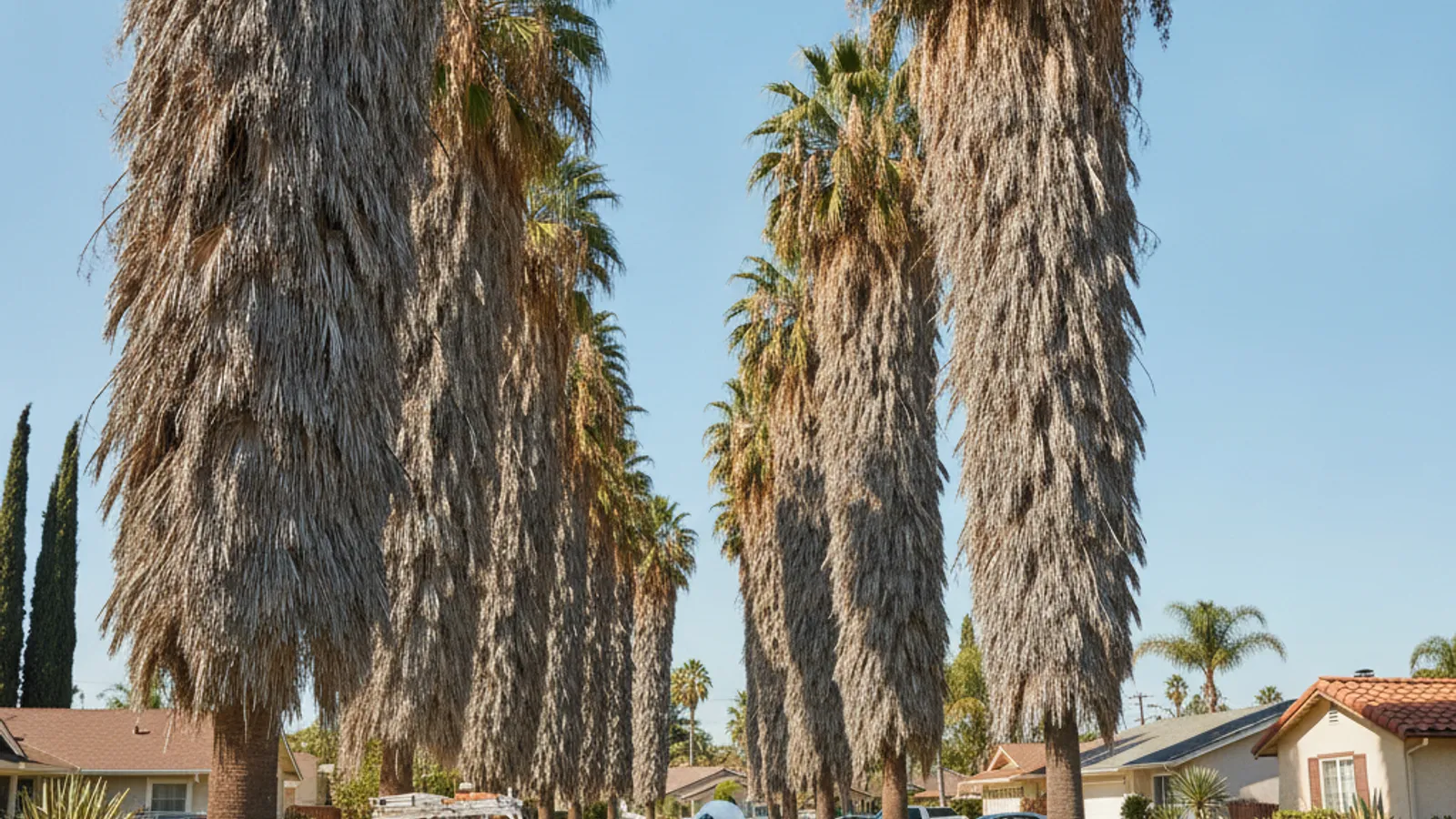
A Mexican fan palm (Washingtonia robusta) usually needs its dead fronds cleared, not its green ones cut. Skinning the trunk wounds the tree. Removal makes sense when the palm has outgrown its spot, sits near power lines or a structure, or the skirt of dead fronds is more than anyone can safely maintain. The work is dangerous enough that who you hire matters more than which option you pick.
What a Mexican fan palm is and how tall it gets
It’s the tall, thin-trunked fan palm common in San Diego landscapes. The University of Florida’s extension service describes it as a fast-growing species that can reach heights of 70 to 100 feet, too tall for typical residential landscapes. The University of California Cooperative Extension also notes that dead foliage often breaks loose on its own, so it can be a hazard if not removed often.
That height drives every decision below. As the trunk gets taller, trimming, skinning, and clearance from roofs and power lines all get harder.
Why trimming a tall fan palm is dangerous for the worker
The main danger isn’t the height alone. It’s the skirt of dead fronds that hangs around the trunk. In the California FACE program’s report on one February 2023 palm trimmer death in a California front yard, some cut fronds intertwined, forming a skirt around the tree trunk above him. The worker was cutting from underneath. The skirt then slid down the trunk and the cause of death was traumatic asphyxia.
That is a single case report from a NIOSH-funded program run out of the California Department of Public Health, based on preliminary data, and it doesn’t name the palm species. It isn’t a statistic about how often this happens. The palms at that job were approximately 80 feet high, and the dead fronds began approximately 50 feet up from the ground. A University of California Cooperative Extension newsletter written for the Central Valley gives similar advice: fatalities have occurred when pruning from below and the bundle of fronds landed on top of the worker.
The report’s recommendations for companies are specific. Safe methods for trimming palm trees include using an aerial lift equipped with fall protection. The alternative is a climbing procedure that places the worker above the fronds when there’s more than three years of frond growth, and only by trained, experienced tree workers.
For you as the owner, this means two things:
- A crew that plans to climb up and cut the skirt from beneath the fronds is using the method the report lists as an improper work practice.
- A palm with years of accumulated dead fronds needs a lift or an above-the-skirt climbing plan. Ask which one the pro intends to use before you agree to anything.
The report also says homeowners should only hire tree trimmers and/or supervisors who are certified by organizations such as the International Society of Arboriculture (ISA), and have a tree service contractor’s license (the report adds “in states where this is applicable”). More on licensing below.
Why climbing spikes are a problem for the palm
Spikes are a tree-health issue as well as a safety one. University of California Cooperative Extension says plainly that nails or climbing spikes should never be used to climb palms. Its reason: the wounds they make in the trunk are permanent.
The University of Florida’s extension service adds that trunk wounds from improper pruning, climbing spikes, rough handling during transplanting, or pulling off lower leaves can let the fungus Thielaviopsis in. That’s a trunk rot. So on a palm you intend to keep, ask whether the pro climbs with spikes. For a palm that’s coming down anyway, the trunk wound doesn’t matter.
Over-trimming: the “hurricane cut”
Cutting too much is a known palm-care mistake. The University of Florida’s extension service calls the “hurricane cut” unfortunately common in Florida and harmful to palms. If it’s repeated, the palm can even develop smaller leaf sizes and a smaller trunk diameter.
Its rules are short. A rule of thumb is to only remove fully brown fronds, and the number-one rule about pruning palms is to never remove live, green, healthy fronds. A crew that offers to “clean it up” by stripping the crown to a tuft isn’t helping the palm.
For timing and technique that apply to San Diego yards, see our guide to palm tree trimming season in San Diego and how to prune a palm tree.
What skinning is, and the tradeoffs
Skinning means cutting the old leaf bases off the trunk after the fronds are gone, so the trunk looks smooth instead of shaggy. Some owners and HOAs want that look.
The tradeoff is the trunk. University of California Cooperative Extension advises leaving the leaf bases on, and it recommends that you avoid skinning or shaving the trunks as it wounds the trunk and makes it easier for disease or insects to invade the tree. Its preferred approach is to clip the old fronds and leave the leaf bases until they are completely dried and easy to remove.
A second UC extension guide goes further about power tools. It warns that over zealous leaf removal and trunk skinning with a chain saw can leave gaping wounds through which diseases can enter the trunk and cause decay.
So skinning is a cosmetic choice with a cost to the tree. If you want it, ask the pro what tool they use, how deep they cut, and how they sanitize between palms.
Invasive and flammable: the California side of this palm
The Mexican fan palm isn’t only a yard problem. The California Invasive Plant Council notes it’s found on California’s south coast and that it has become invasive in riparian areas, orchards and landscaped areas. It rates the palm Moderate, with an Alert flag. The page explains that a Moderate rating means substantial and apparent, but generally not severe, ecological impacts. The same page says the palm is known to create monospecific stands in riparian areas, and dead fronds of the tree can create a fire hazard.
University of California Cooperative Extension makes the same fire point for yard palms: dead fronds are often considered unsightly, provide a haven to rodents and there may be a fire hazard associated with them.
Inside the City of San Diego, the fire department has its own test for a dead palm. San Diego Fire-Rescue’s brush policy, FPB Policy B-08-1, deems a palm dead if the majority of fronds are brown or missing and there is no green, live tissue at the growing tip of the crown. In brush management zones, the same policy puts removing dead plants first in the order of work.
Cal-IPC describes the invasion in riparian areas generally. Cal-IPC lists the control methods as pulling seedlings, cutting trunks below their growing point, and drill-and-fill trunk application of herbicide. Whether a county or city rule applies to your lot is a question for your local fire authority. See also invasive tree species in San Diego and defensible space tree requirements.
When removal makes more sense than repeated trimming
Trimming a 70-foot palm is a repeat job that needs a lift or an expert climber every time the skirt builds up. Removal is a one-time job, though a tall palm still needs a skilled crew. These situations tilt toward removal:
- The palm is near power lines. SDG&E says that any tree pruning done around SDG&E power lines must be done by a line-clearance-qualified arborist. It adds that the California Penal Code also makes it illegal for unauthorized persons to work within six feet of high voltage conductors. Don’t prune or climb a palm that close yourself. Read trees near power lines in San Diego first.
- The palm is tall and the skirt is old. A heavy skirt on a tall trunk is the exact setup in the fatality report above.
- It’s close to the house, a pool, or a neighbor’s yard. A fall or a dropped frond has few places to land.
- Seedlings keep showing up. Palm seedlings are a concern in riparian areas, so ask the pro about them.
- The palm is sick. If the crown looks wrong, see common palm tree diseases in San Diego. A pro can tell whether it’s worth saving.
Removal isn’t automatic. A palm in an open yard, with a clear fall zone and a crew that will work from above, can be kept and maintained. For what moves a removal quote, see palm tree removal cost in San Diego, and for the palm species you might choose instead, see types of palm trees in San Diego yards. Rules on removal depend on your city, county, or HOA, so start with our permit guide.
Who can legally do palm work in California
California has a tree and palm license. The Contractors State License Board will accept applications for the new C-49 Tree and Palm Contractor classification starting January 1, 2024. It says the older C-61/D-49 Tree Service class and C-49 differ slightly, since the C-49 description includes palms, but that CSLB regards the work as the same. Contractors who held a C-61/D-49 license before 2024 may retain and work under that classification.
Check the license on the CSLB site before you sign. Also ask for ISA credentials, since the fatality report recommends them for palm work. An ISA credential isn’t a state license, and a license doesn’t prove palm skill. You want both.
Frequently asked questions
Are Mexican fan palms invasive in California?
The California Invasive Plant Council rates Washingtonia robusta Moderate with an Alert flag. It says the palm has become invasive in riparian areas, orchards and landscaped areas. The profile doesn’t say which San Diego County sites are affected.
Should I trim my Mexican fan palm myself?
Not a tall one. The California FACE report describes one trimmer who worked from underneath a frond skirt on palms about 80 feet high and died. A short palm with few dead fronds is a different job, but keep clear of any power line. Ask a licensed pro about anything taller than you can reach safely from the ground.
Is it bad to over-trim a palm?
Yes. University of Florida extension guidance says the number-one rule about pruning palms is to never remove live, green, healthy fronds. Repeated heavy cuts can shrink new leaves and the trunk.
Does skinning a palm hurt it?
It can. University of California Cooperative Extension says to avoid skinning or shaving the trunks as it wounds the trunk and makes it easier for disease or insects to invade the tree. Ask the pro what they’d do instead.
Who decides whether a palm near a power line can be pruned?
SDG&E says pruning around its lines must be done by a line-clearance-qualified arborist. Contact SDG&E before anyone prunes the palm.
The short version
A Mexican fan palm can grow 70 feet or taller, and the dead skirt is the hazard. Trim only dead fronds. Skip skinning and spikes if you’re keeping the tree. Remove it when it’s near lines or structures, or when maintaining it needs a lift every time. Hire a licensed pro who works from above the skirt.
When to call a tree professional
If your palm is tall, close to power lines, or has years of dead fronds, call (858) 400-4587. Limb SD will connect you with a licensed and insured independent tree professional, and you can discuss trimming, skinning, or removal with that pro directly.