Limb SD connects property owners with licensed and insured independent tree professionals across San Diego County. Limb SD holds no trade licenses and performs no tree work. The customer hires and pays the matched professional directly.
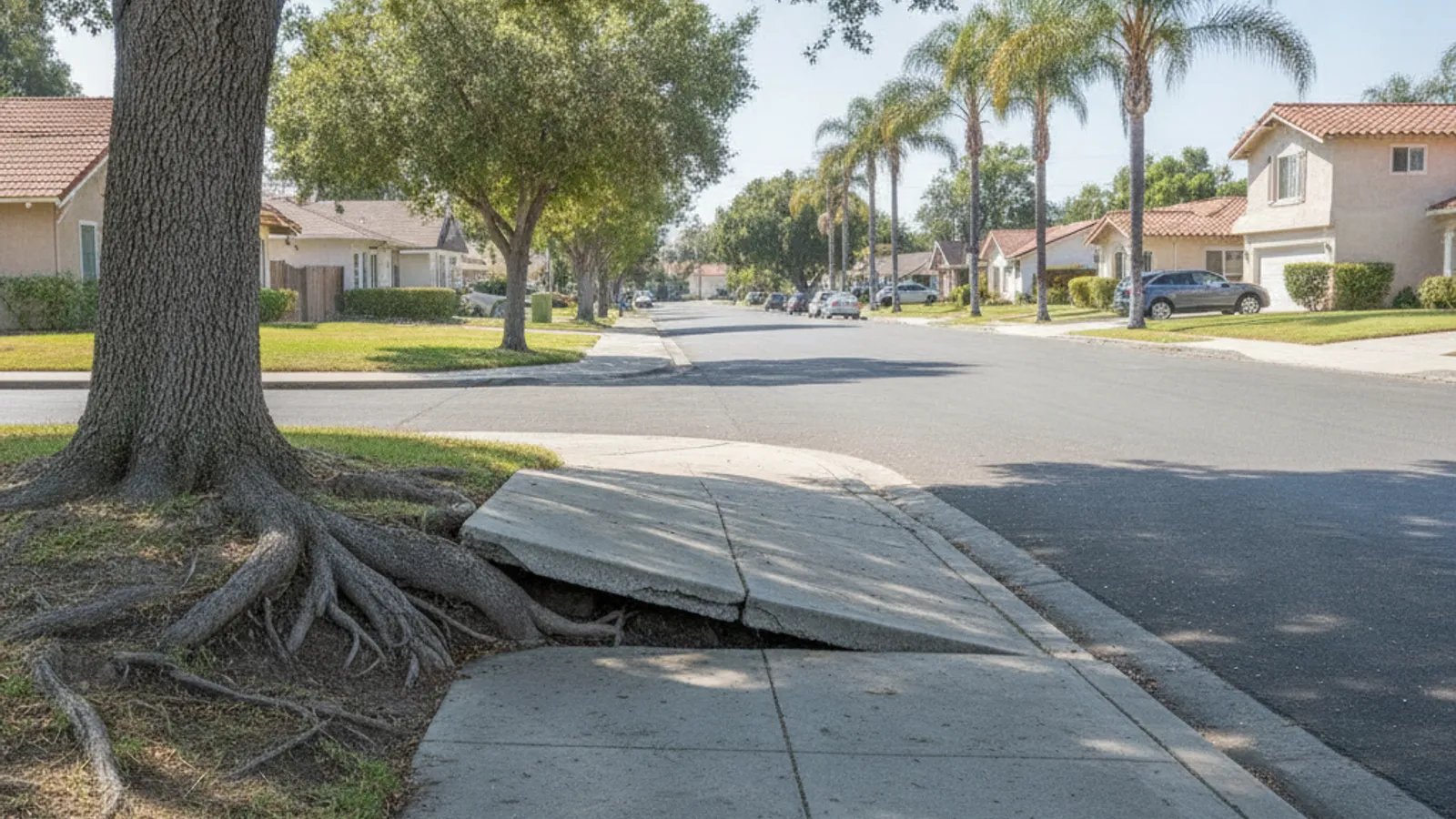
A root barrier is sometimes worth it, mostly when it goes in at planting time and the tree sits close to pavement. Next to an established tree, installing one means trenching through roots, which carries its own risk. The studies found barriers reduce surface roots, but roots often returned. Here’s what the studies found, what changes in San Diego yards, and what to do instead.
What does a root barrier actually do?
A vertical root barrier is a panel or sleeve set in the soil to redirect roots. Researchers describe the goal as to “redirect root growth to greater depths in the soil, thus reducing damage to the sidewalks.” It doesn’t stop roots from growing. It pushes them down and around.
There are two layouts. A circular barrier surrounds the rootball of a newly planted tree. A linear barrier is a straight panel between the tree and the thing you’re protecting. A review of 40 years of barrier research notes that “circular configurations are used only for new plantings.”
Do root barriers work?
They work partly. The results depend on the tree, the soil, and how long you wait.
In a Southern California study at UC Riverside, Pittenger and Hodel tested circular barriers on Indian laurel fig (Ficus microcarpa) and American sweetgum. Six years later, the barriers had “nearly eliminated large (diameter 5 cm [2 in] or greater) surface tree roots within a 120 cm (48 in) radius of the trunk.”
The same study found the limits. Roots “grew below barriers and returned to the surface soil” near the bottom of the barrier. Small roots just outside the barrier kept growing in the top 6 inches of soil. The authors say the results underscore earlier conclusions “that root barriers only delay problems from surface roots.” A barrier made from a 15-gallon nursery container also reduced the trees’ trunk growth.
A sidewalk trial by Gilman in Gainesville, Florida, planted 48 sycamores beside test sidewalks and dug up the roots eight years later. It points the same way. Roots deflected by the vertical barriers “were forced deeper into the soil, but many returned to the surface by the time they reached the opposite side of the walk.” On well-drained soil, vertical barriers “did not increase root depth compared to the control.” A gravel layer under the walk did better there.
A seven-year willow oak study by Smiley in Charlotte, North Carolina, found that all five barrier products “significantly reduced the amount of root growth compared with the control trees,” and no product beat the others. The same paper reports that “many more roots were found growing under, over, and through root barriers after seven seasons” than after two.
These trials used a few species, in Riverside, Gainesville, and Charlotte, not in San Diego soil. A barrier can cut the number of roots near pavement for years. None of the studies promises the pavement stays flat.
Why roots stay shallow in San Diego yards
UC IPM says plants “generally have shallower roots when they are young or receive relatively frequent and light irrigations.” The same page notes that irrigation is required to maintain most urban landscapes in California, where rainless weather prevails through much of the growing season. A yard watered with short, frequent cycles invites surface roots.
A review of tree and sidewalk conflicts says the potential for conflict is high when one or more of these factors is present: large or fast-growing species, restricted soil volumes, shallow topsoil over hardpan, trees less than 2.0 to 3.0 meters from the sidewalk, and trees older than 15 to 20 years. A narrow strip or a tight side yard can meet several of those conditions at once.
Which of these applies to your yard depends on your soil and your irrigation schedule. A tree professional can read the site.
Installing at planting vs retrofitting an established tree
At planting, a barrier goes in before roots exist outside it. That’s the case the research mostly tests.
Beside an established tree, the work starts with a trench, and a trench cuts whatever roots are in its path. UC IPM’s guidance on protecting trees during construction is direct: “Avoid crushing or cutting roots, especially those larger than about 2 inches in diameter.” It adds that when large roots are cut or injured, “the tree becomes more likely to be blown over by wind, especially if the soil is wet.”
Retrofit barriers also raise a fair question about the payoff. The tree has already built its root system. Cutting roots to protect a slab can add a new risk to the tree. For help, UC IPM says to consult a tree-care professional, such as an arborist certified by the International Society of Arboriculture.
Which San Diego trees cause the most hardscape trouble?
Ficus is one species researchers have tested. The UC Riverside study used Indian laurel fig and sweetgum, which it describes as commonly planted trees “observed to develop extensive surface roots.” In that study, ficus roots occasionally breached the thinner barrier materials. For species-level detail on local ficus, read the ficus tree guide for San Diego.
Whether a specific tree is lifting your slab is a question for an on-site look, not a species list. The eucalyptus guide covers that tree’s hazards.
What if the sidewalk and tree belong to the City?
If the tree belongs to the City, start with the City, not a shovel. The City of San Diego’s street tree maintenance page says a City-maintained tree causing sidewalk damage should be reported to the City, and that tree roots “can cause uplifting of sidewalk panels,” and lists root pruning, root barriers, sidewalk cutouts, ramping, tree root bridge plates, and sidewalk realignments as remedies. The same page says you “may request a No-Fee Permit for trimming, removal, planting or root pruning following inspection by City staff.” City-maintained tree issues are reported through Get It Done. Confirm with the City whether a barrier would be allowed.
Who pays for sidewalk repair is its own question. Start with who is responsible for street tree trimming and the City tree removal guide, and confirm the specifics with the City.
Better options than a barrier
Pick the right tree for the space. The City’s Street Tree Selection Guide is built to encourage “choices compatible with the planting locations, minimizing damage to other public improvements.” It sorts species by parkway width, starting at “PARKWAYS BETWEEN 2-FT. AND 4-FT. WIDE OR LARGER,” and says to refer to the applicable Master Street Tree Plan.
Leave space. Pittenger and Hodel wrote: “Keeping pavement at least 120 cm (48 in) away from trees would be as effective as a root barrier in reducing the possibility of damage from large surface roots.” For large surface roots on a new planting, distance can do much of the barrier’s job.
Water deeper, less often. UC IPM says roots are usually deeper in plants growing in “well-aerated soils with good drainage and less-frequent but deep irrigation.” Ask your landscaper or irrigation contractor about the schedule.
Have an arborist prune roots. Where roots are already lifting pavement, a pro can judge which roots can go and which hold the tree up. The City’s own list of remedies includes root pruning. See tree pruning and arborist consultation.
Consider replacement. If a tree is too big for its spot, removal and a better-matched replacement can be the cleaner fix. Quotes move with trunk size, access, root work, and final grade. Compare them in the tree removal pricing guide.
Frequently asked questions
Are root barriers worth it for a new tree near a sidewalk?
Sometimes, with limits. Studies show barriers cut large surface roots near the trunk for years. Roots can still grow under and return to the surface, so planting farther from pavement helps more.
Do root barriers work on ficus?
Partly. In the UC Riverside study, barriers reduced ficus roots within a 120 cm radius, though ficus roots occasionally breached thinner materials.
Can I add a root barrier next to a mature tree?
It’s possible, but the trench cuts roots. UC IPM warns that cutting large roots raises the odds a tree blows over. Ask an ISA-certified arborist before anyone digs.
Will a barrier hurt the tree?
It can. The Riverside study found that a 15-gallon container barrier reduced trunk growth. Cutting roots to install one can add stress.
Can I install a barrier by a City street tree?
Start with the City. It says to report City-maintained tree issues through Get It Done, and a No-Fee Permit for root pruning follows City inspection. Confirm with the City before anyone digs.
How do I stop roots from lifting my driveway?
Start with a site visit. The fix depends on the tree, the distance, and the soil. Options include root pruning, adding space, changing irrigation, or replacing the tree.
The short version
A barrier delays surface roots. It doesn’t end them. It fits best at planting, with the right species and enough space. Next to an older tree, get an arborist’s opinion first. Near a City tree, talk to the City first.
When to call a tree professional
Call when roots are lifting pavement, when you’re weighing a barrier next to a mature tree, or when a tree is too big for its spot. Call (858) 400-4587 and Limb SD will connect you with a licensed local tree professional.