A damaged tree beside a roof or driveway needs more than a photo review. A site assessment helps determine whether removal, pruning, or continued monitoring fits the actual condition.
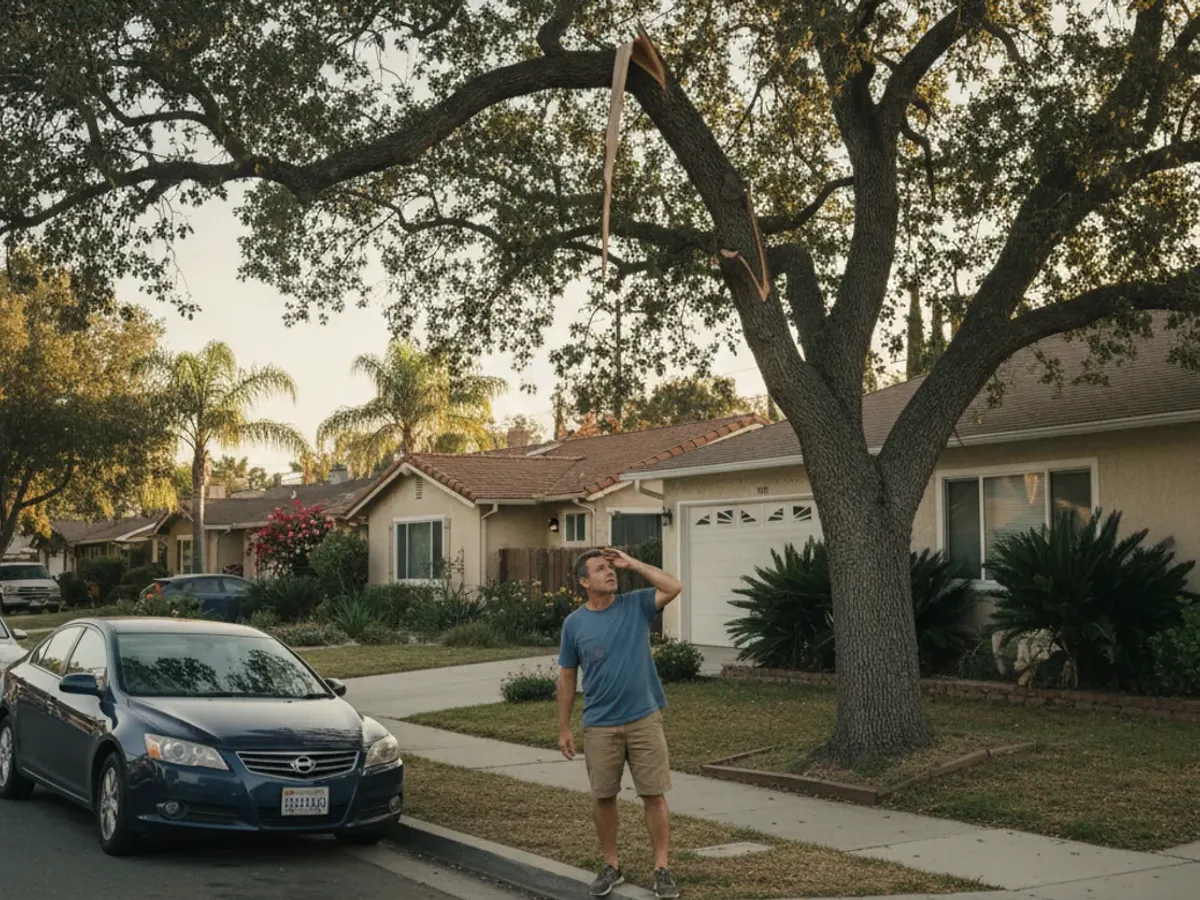
Which visible changes warrant a closer assessment
Start with changes you can observe safely from the ground. Fresh movement deserves attention, especially after wind or construction. Look for a new lean, lifted soil, exposed roots, or cracks near the trunk base. Those changes may indicate movement, but they don’t establish the cause.
A hanging limb or an opening branch union also warrants review. So does a limb that recently shifted over a roof, driveway, or occupied patio. Keep people away from the area until a qualified professional evaluates it. Don’t climb the tree, pull the limb, or stand beneath it for photographs.
Canopy changes also provide useful context. Note sudden thinning, dead sections, unusual leaf loss, or one side declining faster than the other. Our guide to signs a tree may be dying explains why these observations need context. A sparse canopy could reflect root trouble, pests, disease, water stress, or another cause.
Species and location matter in San Diego. Coast live oaks can face goldspotted oak borer damage. Canary Island date palms can be damaged by South American palm weevils. Eucalyptus, Torrey pines, and other mature trees have their own structural and health concerns. A professional needs to identify the tree before interpreting symptoms.
Report changes over time, not just what appears today. Recent trenching, irrigation changes, vehicle traffic, grading, or storm damage can help explain what the assessor sees. If the tree touches or threatens a power line, stay away and contact the utility before arranging ordinary tree work.
Why one warning sign doesn’t prove failure
A single symptom rarely answers the removal question. A lean can be old or recent. A hollow may affect only part of the trunk. Dead branches can be isolated while the remaining structure stays under evaluation. Even green foliage doesn’t prove that the trunk, roots, and branch attachments are sound.
That uncertainty is why a hazardous tree assessment happens on site. The professional considers the tree’s condition, its surroundings, and what could be struck. They may inspect the root collar, trunk, major unions, canopy, and visible soil movement. They should also ask when the change appeared and whether nearby work disturbed the site.
Photos can help describe the concern before a visit. They can’t show hidden decay, root anchorage, or movement under load. Avoid treating online image matching as a diagnosis. Our guide, Is my tree going to fall?, explains how warning signs fit into a wider assessment.
Pest symptoms need the same care. Crown thinning and bark staining aren’t enough to confirm goldspotted oak borer. Palm decline can also have several possible causes. Correct identification matters because treatment, pruning, monitoring, and removal address different problems.
An assessment shouldn’t begin with a predetermined removal verdict. The purpose is to understand the tree, the targets, and the available options. If you want an independent evaluation before requesting removal proposals, ask about an arborist consultation. Confirm the scope first, including whether written findings are included.
How nearby targets affect the removal decision
A tree condition becomes more urgent when people or property could be struck. Professionals call those people, structures, vehicles, and activity areas targets. The same visible defect can lead to different recommendations in an unused corner and beside a bedroom.
Walk the property from a safe distance. Identify the house, garage, driveway, sidewalk, play area, pool, neighboring property, and public right-of-way. Tell the assessor when each area is occupied. A driveway used daily presents a different situation from an empty slope.
San Diego lots also create access limits. Narrow side yards, gates, walls, slopes, pools, and overhead lines can affect the removal plan. A crew may need a different method when branches extend above a roof or neighboring parcel. Equipment choice should follow the actual site assessment, not the species name alone.
Ownership and jurisdiction matter too. A tree near the curb may be private, City-maintained, or within the public right-of-way. In the City of San Diego, street-tree work follows the City’s inspection and permit process. A private contractor’s availability isn’t permission to remove a street tree. Homeowners seeking tree service in San Diego should identify the tree’s exact location before approving work.
Property lines deserve similar care. A fence doesn’t prove the legal boundary. Branches or roots crossing a line don’t automatically authorize destructive cutting. Tell the assessor about boundary questions, easements, HOA rules, and shared access before the quote is prepared.
Removal can address the assessed tree. It can’t eliminate every property risk. Other trees, drainage problems, unstable slopes, utility conflicts, and damaged structures may require separate attention.
When pruning or monitoring may remain options
Removal isn’t the only possible outcome. Purpose-based pruning may address a damaged or poorly positioned branch when the remaining tree can be retained. Monitoring may also remain an option when the assessor finds no condition requiring immediate work.
The recommendation should name the objective. “Trim the tree” is too vague. A written scope should identify the branches involved and explain whether the goal is clearance, deadwood removal, structural improvement, or another defined result.
Hazardous limb removal is different from removing the whole tree. The assessor should consider the limb’s attachment, condition, size, location, and the consequences of cutting it. Excessive foliage removal can stress a tree and reduce its energy reserves. Indiscriminate topping can also create weakly attached new growth. The International Society of Arboriculture’s homeowner resources explain why pruning decisions should match the tree and objective.
Monitoring also needs a clear plan. Ask what change should trigger another assessment. That might include fresh soil movement, a widening crack, additional branch failure, or a changing lean. Ask who will perform the follow-up and whether any written record is included.
Pruning and monitoring aren’t promises that a tree can’t fail. Supplemental support systems also have limits and require continuing inspection. When the remaining risk isn’t acceptable, tree removal may be the recommended path.
Urgent conditions shouldn’t wait for a routine monitoring schedule. Keep away from an actively moving tree, split trunk, hanging limb, or disturbed root plate. If electrical lines are involved, contact the utility from a safe location before calling a private tree company.
What the tree crew needs before preparing a quote
A useful quote starts with the tree and the site. Give the company the property address, tree location, and your main concern. Share safe ground-level photos, but expect the final scope to depend on an on-site review.
Describe what changed and when. Mention recent wind, excavation, irrigation changes, construction, branch failure, or vehicle impact. Point out nearby roofs, parked cars, public sidewalks, utility lines, fences, and neighboring property.
Access details can change the work plan. Show the company gate widths, steps, slopes, soft ground, septic features, underground utilities, and areas that equipment must avoid. Known subsurface tanks, voids, and utilities matter when heavy equipment is considered. Public utility marks also don’t identify every private line.
Ask the company to separate each part of the proposed work:
- Tree or limb removal scope
- Pruning included before removal
- Rigging or equipment plan
- Protection of nearby structures and surfaces
- Debris, logs, and wood-chip handling
- Stump work, if requested
- Final cleanup and grading responsibilities
- Permit or property-authorization responsibilities
- Exclusions and possible added work
No verified official source publishes a standard San Diego price for hazardous tree removal. The company preparing the proposal sets its own price. Tree size, access, nearby targets, removal method, debris handling, and stump scope can all affect that proposal. Get the terms in writing before work begins.
Check the contractor through the California Contractors State License Board. Confirm the classification fits the proposed work and verify the current record. An ISA credential belongs to an individual and isn’t the same as a California contractor license.
Limb SD is a referral service. We connect homeowners with licensed, independent local tree companies. The customer contracts with and pays the selected company directly.
When to call us
Call when a damaged tree, shifting root area, hanging limb, or nearby target makes an on-site assessment necessary. We’ll match you with a licensed local tree company that can inspect the site and prepare its own proposed scope.
Call us at (858) 400-4587 and we’ll connect you with a licensed local tree company.