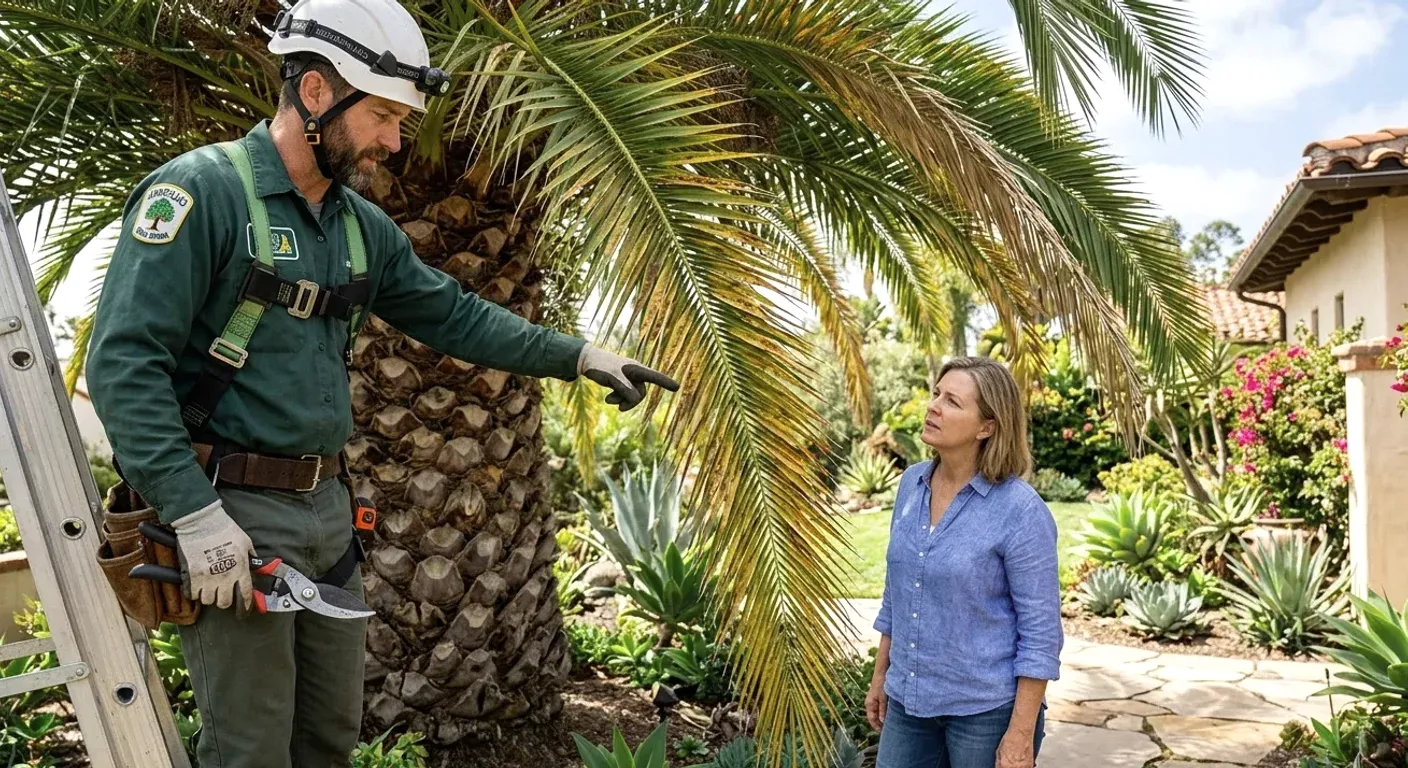
Limb SD connects property owners with licensed and insured independent tree professionals across San Diego County. You hire and pay the matched pro directly. We do not diagnose, treat, or remove any trees ourselves.
A sick palm in this county could have several different problems. Fusarium wilt, diamond scale, pink rot, petiole blight, and Ganoderma butt rot often look similar from the street. Identifying the exact cause requires careful observation before anyone starts work.
Stay on the ground when inspecting a declining palm. Never climb it or cut into the trunk yourself. Call 911 if someone is hurt or in immediate danger. If the palm touches a downed power line, stay far back. Call 911 and SDG&E at 1-800-411-7343 from a safe distance. SDG&E decides whether lines can be de-energized, covered, or moved. Never prune near an energized conductor.
Five common palm problems in the county
Identify the species first. A Canary Island date palm in La Jolla hosts different pathogens than a Mexican fan palm in the South Bay. Matching one symptom does not confirm a diagnosis. Get the cause identified by a professional before approving removal or treatment.
UC IPM’s 2019 palm-disease guide covers Fusarium wilt, diamond scale, petiole blight, and pink rot. California records for Ganoderma come from a separate 2025 report detailed below.
Fusarium wilt. The pathogen Fusarium oxysporum f. sp. canariensis causes fatal vascular decline in landscape Canary Island date palms. No established cure exists. Leaflets dying on only one side of a frond is a strong clue. This disease usually affects more leaves than pink rot or petiole blight. Contaminated sawdust and tools spread the fungus. Do not split open a rachis to check.
Diamond scale. Caused by the fungus Phaeochoropsis neowashingtoniae, this condition produces black diamond-shaped fruiting bodies. It is not an insect and creates no honeydew. UC researchers observed it on California fan palms and Mexican-fan hybrids, but not on pure Mexican fan palms. Coastal sites favor its growth. A palm near the water in Chula Vista faces different humidity than one in inland El Cajon. Premature loss of older leaves is typical. Removing those leaves does not cure the problem.
Petiole and rachis blights. Fungi like Cocoicola and Serenomyces attack date and fan palms. These infections usually stress the plant rather than kill it outright. Damage stays limited compared to a canopy-wide wilt. Proper sanitation and water management help limit spread.
Pink rot. Nalanthamala vermoeseni targets palms that are already wounded or stressed. It damages growing tips and produces pink spores. Its role in trunk decay remains unconfirmed. Fungicide alone will not fix the issue. Pink surface growth does not automatically mean Ganoderma is present.
Ganoderma butt rot. This disease decays the lower trunk. Symptoms overlap heavily with other conditions. Conks might be completely absent. A green canopy does not guarantee the trunk interior is solid.
Ganoderma butt rot records in California
Santos and Hodel’s March 2025 PalmArbor report documents Ganoderma zonatum in California. CDFA sequencing confirmed it from a queen-palm stump following a November 2024 Laguna Hills investigation. DNA later identified a 2017 sample from Carlsbad, though the host species remained uncertain between queen palm and Mexican fan palm. A 2007 observation on a Senegal palm in San Diego stayed suspected rather than confirmed.
These records do not measure how widespread the disease is in local neighborhoods. A random mushroom photo cannot identify G. zonatum. Molecular methods provide reliable identification. No preventive treatment or cure currently exists. Removing a conk does not heal the palm.
Confirmed cases require a removal and risk plan from a qualified professional. Infected wood should never enter recycling mulch streams. Replanting another palm in the same spot carries high risk. Discuss non-palm replacements instead. Do not grind, burn, or chemically treat the stump as a home remedy. Poor drainage and pruning wounds are not proven causes.
Distinguish this lower-trunk rot from sudden crown drop. Sudden crown drop happens even when the canopy looks green, and its primary cause remains unconfirmed. Never tap or skin a trunk to test its strength.
Ruling out the South American palm weevil
If a Canary Island date palm is declining rapidly, insects might be responsible. UC IPM’s giant palm weevil page provides the insect differential.
Rhynchophorus palmarum is established in San Diego County and kills Canary Island date palms. Larvae bore deep inside the trunk. Adults spread it, along with transported infested plant material. Use binoculars from the ground to spot feeding damage in the crown. Never climb into a suspect canopy. Have a professional inspect tissue you cannot safely reach. Report suspected weevils to the San Diego County agricultural commissioner. Do not apply insecticides yourself or dispose of infested material as ordinary green waste.
Pruning practices when disease is suspected
Prune only for a specific safety or health purpose. ISA’s palm brochure recommends removing dead fronds and hazardous fruit clusters. Keep healthy foliage intact. Limited clearance cuts are sometimes appropriate.
Never skin the trunk or carve persistent leaf bases. Those wounds remain open permanently. Protect the terminal bud at all times. Climbing spikes leave lasting damage on living tissue. Read our notes on palm tree trimming season for timing guidance.
For Fusarium-risk palms, debris cleanup and tool disinfection follow strict professional protocols. Wiping blades with household bleach or alcohol does not make them safe. If a product is part of the written plan, the label dictates all precautions. The matched professional explains reentry intervals and safety requirements.
A palm tree service referral begins with the actual species, site access, and your observations. Treatment outcomes depend entirely on the diagnosis.
Understanding what drives the price
Removing or treating a diseased palm involves several variables. The overall cost depends on the palm’s height, species, and trunk diameter. Access matters significantly. A tight backyard in Oceanside costs more to navigate than an open lot in Poway. Hauling heavy infected wood away adds labor. Some sites require a crane, which changes the scope entirely. Local permits may also apply depending on your city. The matched professional quotes the full price before any work starts. You can read more about factors affecting tree removal pricing or specific palm tree removal cost drivers in our related guides.
Frequently asked questions
Why are the fronds turning yellow?
Nutrient shortages, drought stress, aging, fungal infections, and insects all cause yellowing. Take photos of the whole palm, new growth, and trunk base from a safe distance. Then request a professional diagnosis.
Does one yellow frond mean the palm needs removal?
No. Confirm the host species and the underlying cause first. Compare symptoms carefully, then get a written assessment from the matched professional.
Is a mushroom at the base a sign of imminent failure?
Not necessarily. A conk raises structural concerns, but missing conks do not prove the trunk is solid. Request a professional risk assessment.
Should every palm get pruned annually?
No. Cut only for a defined reason. Leave useful living fronds alone. Hazardous hanging material requires attention regardless of the calendar.
When to call a tree professional
Call when decline accelerates, affects one side, or alters the trunk and crown. Call immediately if people or structures sit beneath the canopy. A tree health diagnosis referral starts that formal assessment. Verify credentials through the ISA credential directory. Ask the matched pro for their current digital certificate. For broader yard checks, review our guide on common San Diego tree diseases.
Call (858) 400-4587 and Limb SD will connect you with a licensed local tree professional.