A split branch can turn a familiar yard into a restricted area. Emergency tree trimming is appropriate when damaged wood threatens people, access, structures, or utilities and can’t wait for routine pruning.
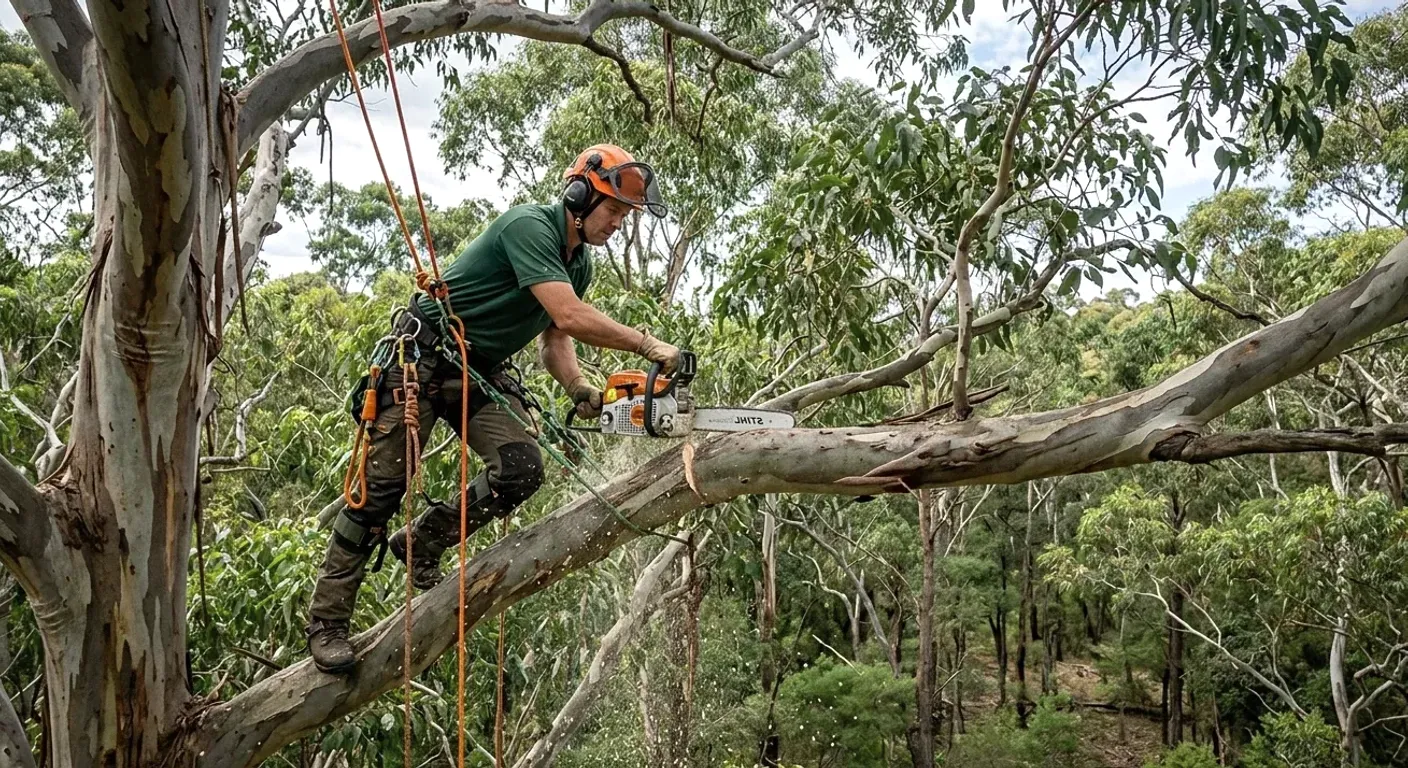
Which damaged branches require immediate separation
A broken branch doesn’t always require immediate cutting. It does require immediate separation when people could enter its fall area. Keep children, pets, vehicles, and visitors away from hanging or partly attached wood.
Treat these conditions as reasons to restrict access:
- A limb hangs over a doorway, walkway, driveway, or play area.
- A fresh split continues into the trunk or a larger supporting branch.
- A branch rests on a roof, fence, vehicle, or another tree.
- Broken wood moves, drops debris, or changes position.
- The tree’s root plate or nearby soil has shifted.
- A suspended branch blocks the only practical exit.
Don’t stand beneath the limb to judge its size. Don’t pull it with a rope or push it using a ladder. A branch may be supported at several points, and cutting one section can change the load on every other section.
The safest first action is distance. Move people to another part of the property. Use an existing fence or closed door to control access when possible. Don’t enter the area merely to install tape or cones.
A eucalyptus limb above a driveway presents a different problem than a queen palm frond lying flat in an open yard. A split coast live oak above a patio also needs different planning than small detached twigs. The target, attachment, access, and remaining tree structure determine the response.
For help arranging an assessment, see our emergency tree service. Limb SD connects homeowners with licensed, independent local tree companies. The provider decides whether hazardous limb removal, limited pruning, or a larger removal plan fits the site.
When utilities or blocked roads change the first call
Electrical contact changes the first call. If a tree or branch touches a line, brings one down, or leaves a line obstructing the work area, stay away. Report a downed line to 911 and SDG&E at 1-800-411-7343. The utility decides whether lines must be de-energized, covered, or moved.
Don’t assume a line is safe because the power appears off. Don’t touch the tree, a fence, a vehicle, or another object contacting the line. Keep tools, ladders, ropes, and equipment outside the area. A tree contractor’s license doesn’t establish electrical line-clearance qualifications.
A blocked public road also requires a different response from a blocked private driveway. Call 911 when the obstruction creates an immediate danger. For a City of San Diego maintained tree, report the issue through the City’s Get It Done system. City staff determine immediate safety conditions. Private contractor availability doesn’t authorize work on a City tree.
Street-tree rules differ across San Diego County. Carlsbad, Chula Vista, Encinitas, and other cities have their own processes. Confirm the tree’s location and jurisdiction before authorizing non-emergency work. A tree beside a sidewalk may be private, public, or within a right-of-way.
For City-specific service information, visit our San Diego tree service page. If the whole tree has fallen, the decisions extend beyond trimming. Our emergency tree removal guide explains that separate situation.
Once utilities and public access are addressed, the independent tree company can evaluate the remaining tree hazard. Ordinary cleanup comes after emergency agencies and the utility have released the relevant area.
How crews inspect a split or hanging limb
A useful inspection starts from a safe position. The tree professional needs to understand what failed, what remains attached, and what the damaged section could strike. The goal isn’t simply to find a place for the first cut.
The initial review should consider:
- The split’s location and direction
- The remaining attachment between branch and trunk
- Other branches supporting or pressing against the damaged limb
- The condition of the trunk and major unions
- Visible root movement or disturbed soil
- Nearby roofs, fences, vehicles, lines, and occupied areas
- Equipment access and possible load paths
- The effect of pruning on the remaining canopy
Wood under tension can move when a cut changes its support. A branch resting on a roof may also be carrying loads that aren’t visible from the ground. That’s why emergency tree limb removal needs a planned sequence, not an improvised chainsaw cut.
Inspection can also reveal that the broken branch isn’t the only concern. A green canopy doesn’t establish that the trunk, roots, or branch attachment are sound. Construction damage, soil disturbance, old pruning wounds, and additional splits can affect the recommendation. These observations don’t prove a cause by themselves.
The provider may propose rigging, an aerial device, crane-assisted work, or another access method. No single method fits every property. Ground firmness, slope, drainage, overhead space, and known underground features affect equipment setup.
Ask for a written scope identifying the damaged branch and nearby work. It should distinguish emergency cuts from optional tree trimming and shaping. Ask whether debris removal, roof access, traffic control, and final cleanup are included. If an individual claims an ISA credential, it can be checked through ISA’s arborist resources.
When trimming may not resolve the hazard
Emergency trimming removes specified damaged wood. It doesn’t guarantee that the remaining tree won’t fail. A wider assessment may show that pruning alone leaves an unacceptable condition.
A split extending into the main trunk can be more serious than an isolated branch break. Fresh root movement can point to an anchorage problem that canopy cuts won’t repair. Multiple damaged stems may also change the work from hazardous limb removal to a whole-tree decision.
Supplemental support is another possible recommendation for selected trees. Cabling and bracing can support certain weak attachments, but they don’t eliminate failure risk. They also require a tree-specific inspection and an ongoing review plan. A crown cable doesn’t prove that the roots are stable.
Removal may be considered when the remaining structure can’t meet the property owner’s risk objective. That decision should account for the tree, its targets, available alternatives, and any applicable authorization. Species alone isn’t enough. A eucalyptus, Torrey pine, coast live oak, or queen palm shouldn’t be condemned only because of its name.
Permits or City approval may apply to street trees and certain designated trees. The exact requirement depends on the parcel, jurisdiction, tree status, and proposed work. Don’t let a private crew remove a public tree without the responsible authority’s approval.
California contractor credentials are separate from an individual arborist credential. Check the proposed contractor through the CSLB license lookup. Current C-49 and valid legacy C-61/D-49 classifications may apply to tree work, depending on the provider and scope.
Our guide to who to call after a tree falls covers utility, insurance, and property questions when the damage extends beyond one limb.
What to document before work begins
Document the scene only from a safe location. Don’t walk beneath hanging wood or enter a damaged structure for photographs. Zoom from outside the restricted area instead.
Start with wide images showing the entire tree and surrounding property. Include the damaged limb, trunk, roofline, driveway, fence, nearby lines, and equipment access. Then record closer views only when they’re visible without approaching the hazard.
Write down what you observed:
- When the branch failed or was first noticed
- Whether wind, rain, or another event had occurred
- What the branch contacted
- Whether access, utilities, or structures were affected
- Any movement noticed after the initial failure
- Which areas of the property remain inaccessible
These notes don’t establish why the branch failed. They give the provider, utility, insurer, or building professional a clearer starting point.
Before work begins, request a written proposal. It should name the tree, identify the emergency scope, and state what happens to debris. Ask who handles permits, public-space coordination, traffic control, utility arrangements, and damage to structures. Confirm whether the proposal covers only the hanging limb or includes inspection of the remaining tree.
Pricing for emergency tree trimming couldn’t be confirmed from an approved public source. Tree size, access, targets, equipment, debris, and utility involvement can change the scope. Ask the independent provider for a current written price and exclusions before authorizing work, when conditions allow.
For an insurance claim, contact the insurer promptly and follow its documentation instructions. Coverage, deductibles, debris allowances, and tree-removal limits depend on the actual policy. A certificate of insurance isn’t the policy and doesn’t change its terms. Ask the contractor and insurer to resolve any coverage questions before non-emergency work starts.
When to call us
Call when a split, hanging, or storm-damaged limb needs assessment by a licensed Tree Service pro. Limb SD will refer you to an independent local provider, who will inspect the site and propose the work.
Call us at (858) 400-4587 and we’ll connect you with a licensed local tree company.