Limb SD is a referral service. We connect property owners with licensed and insured independent local tree professionals. You hire and pay that professional directly. Limb SD performs no tree work itself.
Secure the area before anything else
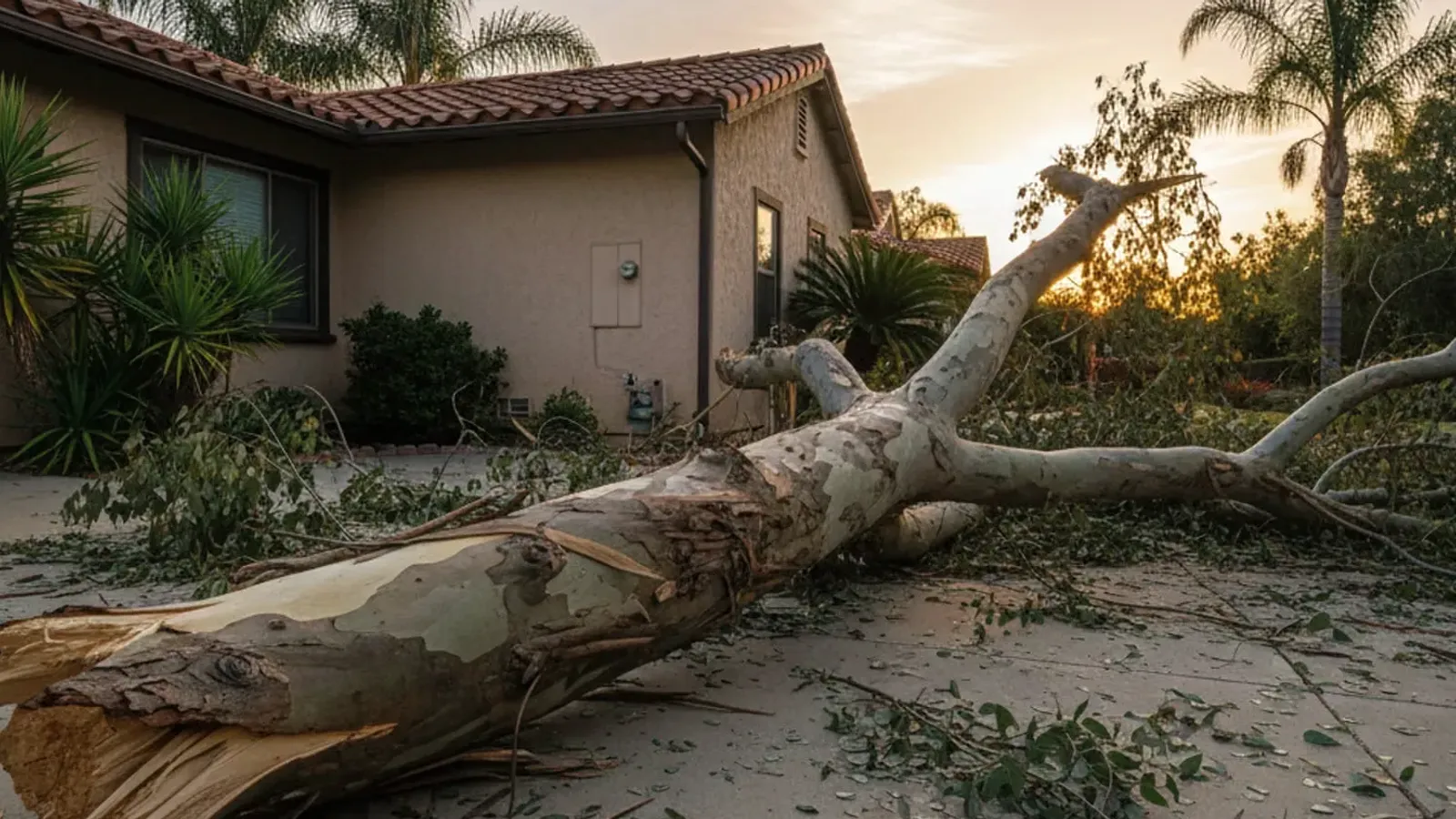
A fallen tree turns a yard into a hazard zone fast. Move people and pets away using clear paths. Never walk under hanging limbs or across downed cables. Tensioned wood shifts without warning when you touch it. Climbing a toppled trunk invites serious injury. Leave stabilization decisions to first responders. Do not enter a damaged building until officials clear it. Take photos only from safe, approved public areas. Capture wide views without crossing any safety barriers.
Call 911 if someone is hurt or trapped. Report downed power lines to SDG&E at 1-800-411-7343. File both reports even if wires look dead. Read the SDG&E downed-line guidance for exact reporting steps. Private contractors cannot declare utility equipment safe. Only the utility decides whether to de-energize or move lines. A quote call does not replace an emergency utility report. Check SDG&E power-outage safety for further details.
Figure out who controls the fallen tree
Tree location determines who authorizes the cleanup work. A trunk in your private yard involves you, your insurer, or your utility company. Street trees fall under municipal rules. The City of San Diego handles its street trees through the Get It Done system. Municipal work requires inspection and permits before anyone cuts. Contractor availability does not authorize city tree work. Read the City of San Diego street-tree maintenance page for local procedures.
Rules change across the county. Chula Vista, Carlsbad, Encinitas, Poway, and Vista each have their own processes. A San Diego mailing address alone proves nothing about jurisdiction. Verify parcel boundaries and right-of-way control status before scheduling work. First responders clear immediate hazards but leave full private cleanup to you. Our network covers every corner of the county, including tree service in San Diego, CA and specific cities like Escondido or El Cajon.
Document the damage for your insurance claim
Photograph the whole tree, the landing spot, and the root plate. Document broken unions, damaged homes, fences, and vehicles. Record utility lines only from a safe distance. Photograph nearby structures, access routes, and personal property. Save claim numbers, estimates, invoices, and repair records. Never move unstable wood just to get a better photo.
The California Department of Insurance states that home damage is generally covered. Review the CA Department of Insurance guidance for current alerts. Coverage depends entirely on your specific policy terms and exceptions. Debris removal and landscaping coverage varies by policy. Vehicle damage requires optional comprehensive auto insurance. Homeowners policies do not cover vehicle strikes. Ask your insurer about pre-adjuster safety work permissions. Confirm required photos, documents, and separate estimate needs. Clarify deductibles and distinct handling for tree versus building damage. Never delay emergency calls waiting for insurance answers. Keep evaluation invoices separate from emergency removal bills.
Understand what the job actually involves
An emergency hazard assessment identifies load-bearing elements first. Assessments cannot predict every hidden defect or failure point. Temporary stabilization scope must define responsibility and duration clearly. Specify whether pruning or full sectional removal applies to your situation. A failed trunk or root plate may force full removal. Cutting, chipping, hauling, and raking are distinct services. Pest symptoms may require separate material handling protocols. Stump grinding, excavation, and grading are separate decisions. Stump grinding happens after the main hazard is gone.
Emergency removal rarely leaves sites ready for rebuilding. Request provider documentation supporting your insurance claim records. Tree removal and building repair are separate jobs. Confirm suspended limbs no longer threaten workers before repairs start. Verify the utility has addressed all involved equipment. Ensure emergency scene restrictions are officially lifted. Obtain insurer claim instructions before non-urgent work begins. Repair contractors must inspect accessible damage first. Let professional findings dictate safety, not deadlines. If you suspect disease caused the failure, consider a tree health diagnosis.
What drives the cost of emergency tree removal in San Diego
No two storm jobs look alike, so prices vary widely. The matched professional quotes before work starts. Size matters most. A massive Torrey pine costs more to process than a small ornamental plum. Position changes everything. A trunk draped over a roof requires different rigging than one flat in a yard. Condition plays a role too. Rotted wood behaves unpredictably under tension.
Structural loads and utility restrictions affect pricing directly. Needing a crane, special rigging, or lift access changes project costs. Ground slope, firmness, and drainage impact equipment choices. Tight traffic, narrow sidewalks, or neighbor constraints alter the scope. Compare inclusions, exclusions, and delegated contractor tasks carefully. Certificates of insurance do not transfer all risk. California Insurance Code section 384 governs policy terms. Demand current proof tied directly to the provider. Read our notes on reading emergency quotes to understand what goes into the numbers.
Check standing trees after the storm passes
One failure does not guarantee future windstorm falls. Inspect nearby trees showing lean or root movement. Check adjacent trees for crown decline or impact damage. Assessments recommend pruning, monitoring, support, or removal. Evaluations cannot predict exactly which tree fails next. Look for cracked tree limbs high in the canopy. Schedule tree trimming for damaged but salvageable branches.
When to call a tree professional
Contact a pro when a tree blocks access, rests on a structure, or tangles with power lines after authorities secure the scene. Never attempt to cut tensioned wood or clear utility lines yourself. Call (858) 400-4587 and Limb SD will connect you with a licensed local tree professional.