Limb SD connects San Diego County property owners with licensed and insured independent tree professionals. Limb SD holds no trade license and performs no tree work. The customer hires and pays the pro directly.
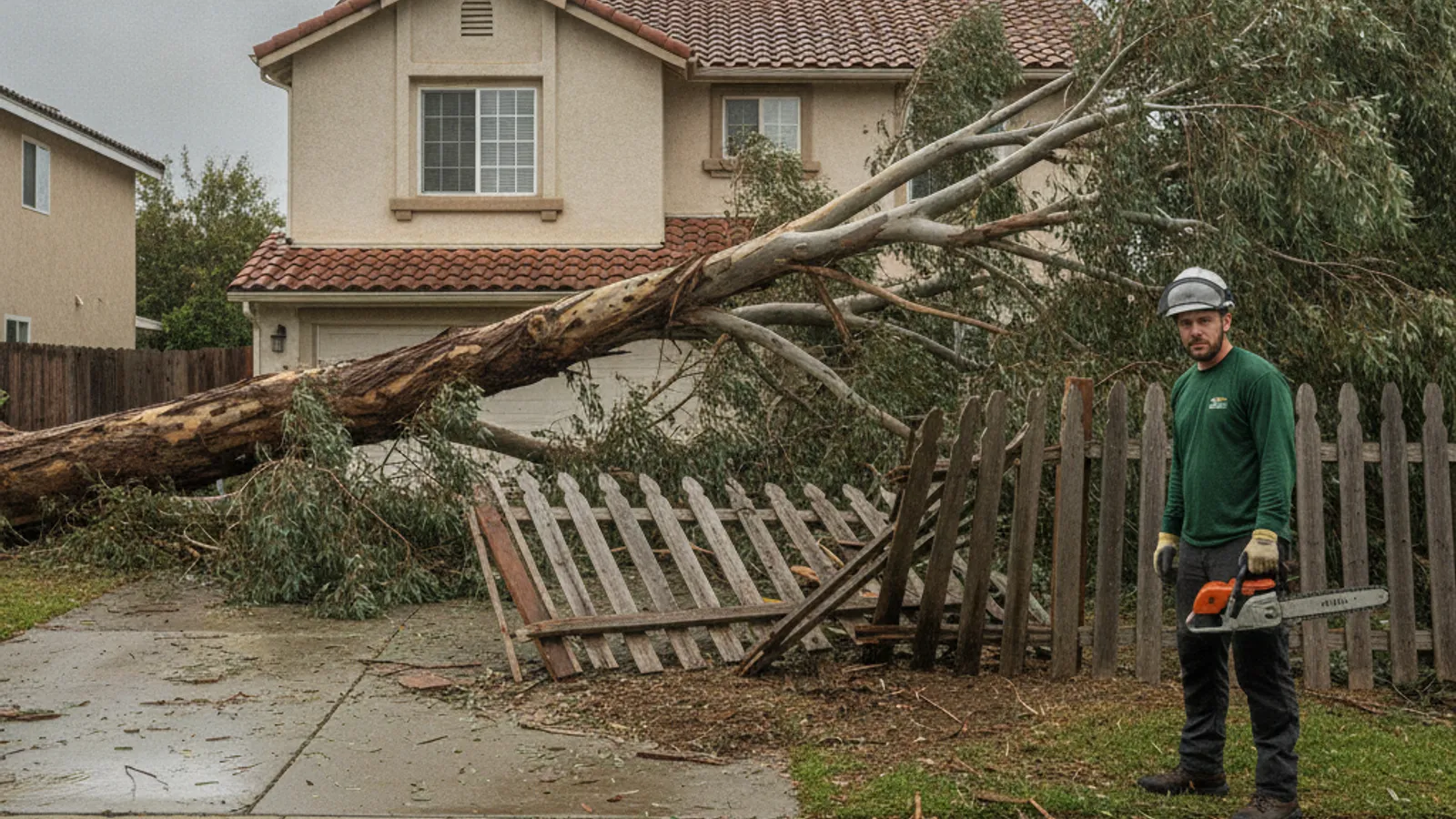
Who you call after a tree falls depends on what the tree is touching. A power line means 911 and SDG&E. A public road means the city or county that maintains it. A house or car means your insurer. A private tree with no hazard attached usually means a tree pro you hire. This page covers the call order and who tends to pay. For securing the site and documenting damage, see our emergency tree removal guide.
What if the tree is on a power line?
Call 911 and SDG&E at 1-800-411-7343. SDG&E’s outage safety page says it directly: “If electrical power lines are down, don’t touch them. Report any downed lines to 911 and call us immediately at 1-800-411-7343.”
Stay clear of the tree too, since it may be holding a live line. The County’s roads department tells residents that when branches interfere with electrical lines, “it is dangerous to trim them yourself. Let the experts at San Diego Gas & Electric do the work.” Book a private tree pro only after the utility has cleared the electrical hazard. More on that handoff is in our trees near power lines guide.
What if the tree is blocking a public road or sidewalk?
The right call depends on which government maintains that street. San Diego County mixes incorporated cities with unincorporated communities, so the same fallen eucalyptus can be a different agency’s job a mile away.
Inside the City of San Diego. The Get It Done page lists “Branch/tree down” and “Blocking street/sidewalk” as tree maintenance request types. It also says: “For urgent street-related issues, dial 619-527-7500” and “For emergencies, dial 9-1-1.”
The City’s tree maintenance page says: “Only dead trees or trees deemed an immediate safety issue by city staff are removed from the right-of-way as soon as possible.” Other removal requests are evaluated under Council Policy 200-5. Our city tree removal guide explains that process.
Unincorporated county roads. Think Alpine, Descanso, Jamul, or Spring Valley. The County Department of Public Works lists an after-hours number of (858) 565-5262 and a business-hours number of (858) 694-3850. Its Road Service Request Form covers “hazards in the roadway” in unincorporated areas. For trees on County right-of-way, the County says “crews will trim the trees that are on County right-of-way at no cost to you.”
Other incorporated cities. Inside any other incorporated city, that city’s own public works handles its streets. The County’s roads site has a separate “Contacts for Cities Within the County” page, which lists city websites. Check your city’s website for its own number.
Not sure whose street it is? The County says to call (858) 694-3850 “to find out if a tree is your responsibility.” Our street tree responsibility guide covers the boundary question.
What if the tree is on my house?
Get everyone out, call 911 if anyone is hurt or a line is down, then call your homeowners insurer. The California Department of Insurance says: “Damage caused from fallen trees are generally covered under all standard homeowner policies. There may be exceptions.” It tells consumers to consult their agent or insurer.
Ask your insurer three things. Does the claim include removing the tree itself? What is the deductible? Does debris removal have its own limit? The Department’s residential claims guide says: “If a covered loss leaves debris that must be removed, this coverage will allow the insured to apply a certain percentage, generally 5%, of the coverage limit to pay for their removal.” Your own policy language controls.
The same guide says tree, shrub, and plant coverage carries “a sub-limit of $500.00 (and in some cases $250.00) for loss to any one tree, shrub, or plant.” That sits in the guide’s discussion of trees as damaged property, so ask your insurer how it applies to your claim.
What if the tree is on my car?
Call your auto insurer. The Department of Insurance says: “Damaged vehicles as a result of fallen trees are generally covered under the ‘Comprehensive or Other than Collision’ portion of the auto policy.” It adds: “Check your auto insurance declaration page to see if this optional coverage was purchased and in effect at the time of loss.”
The Department says only liability coverage is required by law, and calls comprehensive optional coverage worth considering. If you carry only liability, your own auto policy may not pay. In that case, ask whether the tree owner’s insurance is in play, which depends on the fault questions below.
What if a neighbor’s tree fell on my property?
Start with your own insurer, then ask whether the neighbor is responsible. Ownership and fault are separate questions. Under Civil Code section 833, “Trees whose trunks stand wholly upon the land of one owner belong exclusively to him, although their roots grow into the land of another.”
On fault, Civil Code section 1714(a) says: “Everyone is responsible, not only for the result of his or her willful acts, but also for an injury occasioned to another by his or her want of ordinary care or skill in the management of his or her property or person.” The statute also excludes injury a person brought on themselves. Whether a given owner failed to use ordinary care depends on the facts, such as what the tree looked like and what the owner knew.
That statute doesn’t tell you the outcome of your case. Keep your own photos and any written messages with the neighbor. Confirm with your insurer, and with an attorney if the damage is large. Our neighbor tree law guide and HOA tree disputes guide cover the neighbor side in more depth.
Who usually pays, in one table
| Situation | First call | Who generally pays |
|---|---|---|
| Tree on a power line | 911, then SDG&E | SDG&E handles the line; ask SDG&E who handles the tree |
| Tree on a city street | 619-527-7500 or Get It Done | Ask the City; it depends on where the tree stood and who owns it |
| Tree on a County road | (858) 694-3850 or (858) 565-5262 | The County says its crews trim County right-of-way trees at no cost to you; confirm for a fallen tree |
| Tree on your house | Your homeowners insurer | Your policy, subject to deductible and limits |
| Tree on your car | Your auto insurer | Comprehensive coverage, if you carry it |
| Neighbor’s tree on your property | Your insurer first | Depends on fault; confirm with insurer or attorney |
Treat the table as a starting point. Policies differ, and so do the facts of each fall.
Frequently asked questions
Do I call 911 or SDG&E first for a downed line?
Call both. SDG&E’s page says to report downed lines to 911 and call SDG&E at 1-800-411-7343 immediately. Stay away from the line and the tree.
Who removes a fallen tree from a city sidewalk in San Diego?
The City of San Diego removes dead or immediately unsafe trees from its right-of-way as soon as possible. Report it through Get It Done, or call 619-527-7500 for an urgent street hazard.
Does homeowners insurance cover a tree that fell on my house?
The California Department of Insurance says fallen tree damage is generally covered under standard homeowner policies, with possible exceptions. Your deductible and policy limits apply. Confirm with your insurer.
Does auto insurance cover a tree that fell on my car?
Often it does if you carry comprehensive coverage, per the Department of Insurance. Liability-only coverage may not pay for your own car. Check your declarations page.
Is my neighbor responsible when their tree falls on my property?
It depends on fault, and no single rule settles it. Civil Code section 1714(a) addresses injury from a lack of ordinary care in managing property. Ask your insurer or an attorney.
Summary
Call 911 and SDG&E for lines, the right public works office for roads, and your insurer for a house or car. Fault for a neighbor’s tree turns on the facts, so confirm with your insurer.
When to call a tree professional
Once the hazards are cleared and your insurer has been told, you’ll need a pro to remove the tree. Limb SD can connect you with licensed and insured independent tree professionals in your part of San Diego County. Call (858) 400-4587. You hire and pay the pro directly.