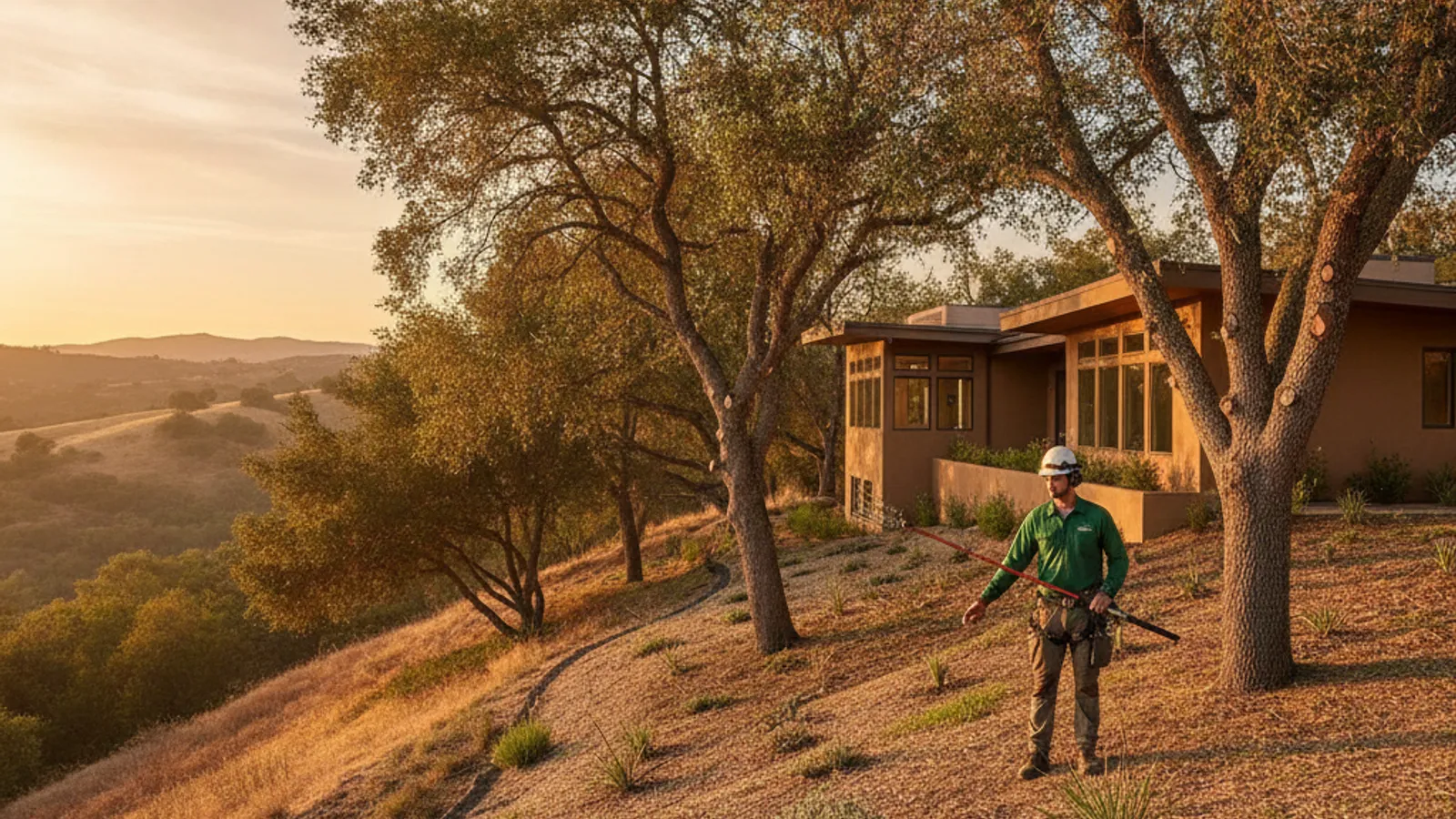
Limb SD connects property owners with licensed and insured independent tree professionals across San Diego County. Limb SD holds no trade licenses and performs no tree work. The customer hires and pays the matched professional directly.
Trimming your trees can help with home insurance in San Diego County, but no single state rule says “trim X and your policy is safe.” The California Department of Insurance (CDI) ties discounts to a list of wildfire safety actions, and following defensible space law, including tree trimming, is one of them. Each insurer then decides how it rates and renews your home. Confirm what yours wants with your insurer or broker.
Does California require you to trim trees for fire insurance?
No statute says “trim your trees or lose your policy.” What exists is a discount framework and a defensible space duty. CDI’s Safer from Wildfires page says “Every action under Safer from Wildfires will qualify you for an insurance discount.” One listed action is “Defensible space compliance,” described as following state and local laws “including trimming trees and removal of brush and debris from yard.”
CDI’s own words are the safe ones to quote. An insurer’s underwriting rules, inspections and renewal decisions are the insurer’s. If you got a letter asking for tree work, the letter controls what you do next.
What the Safer from Wildfires discounts cover
The discounts come from a state regulation. CDI says its Commissioner promulgated permanent regulations “that require insurance companies to give wildfire safety discounts to property owners who have reduced their risk of loss from wildfire by undertaking specific mitigation efforts.” The 2022 CDI announcement says insurers must submit rates that recognize “upgraded roofs and windows, defensible space, and community-wide programs such as Firewise USA.”
The CDI list is not only about trees. It includes:
- A Class A fire-rated roof.
- A 5-foot ember-resistant zone, including fencing.
- Ember- and fire-resistant vents.
- Enclosed eaves and upgraded windows.
- Cleared vegetation, weeds and debris from under decks.
- Removal of combustible sheds and other outbuildings to at least 30 feet.
The ember-resistant zone is the item closest to your trees. CDI says that zone means “Removing greenery and replacing wood chips with stone or decomposed granite 5 feet around your home.” The CDI page lists no discount percentage for tree work. Ask each insurer what it credits.
Zone 0 and trees near the house
The City of San Diego explains that Zone 0 is the area within 5 feet of a home or building, “including outbuildings, attached decks, and stairs.” The City says trees are allowed there “as long as they are properly maintained and regularly pruned.” It also says “Healthy branches must be kept at least five feet from roofs and exterior walls,” and that at maturity the canopy “must be maintained at least 10 feet from roofs and other structures, including chimneys and stovepipes.”
Zone 0 is “required for all new structures built within Very High Fire Severity Zones after February 28, 2026,” per the City. Existing homes are told to “aim to meet” the guidelines. Zone distances and technique sit in our guides on defensible space tree requirements and defensible space in North County.
Your wildfire risk score and how to update it
If an insurer uses a wildfire risk model, state regulation says it must give you the score or class in writing. The CDI 2026 annual notice lists the times: “(2) At least forty-five (45) days prior to each renewal;” and “(3) At least seventy-five (75) days prior to any nonrenewal; and”.
The same notice covers finished work. If you completed a mitigation measure since your last application or renewal, the insurer must provide a revised score no later than thirty days after you ask. The 2022 CDI announcement adds that the rules create “a right to appeal that score.” So after trimming, ask your insurer in writing for a re-score and keep your request.
What to do with a nonrenewal notice
Act quickly, and start with the dates. CDI’s 2026 notice says an insurer must send “a notice of nonrenewal 75 days prior to the expiration that states the reason or reasons for the nonrenewal.” If the insurer misses that, “the existing policy with no change in its terms and conditions, shall remain in effect for 75 days from the date that the notice of nonrenewal is delivered or mailed.”
Then work through these steps:
- Read the stated reason. If it names trees or brush, ask in writing what work and proof would fix it.
- Have the trimming done and documented (see below), then ask for a re-score.
- Shop other carriers. The nonrenewal notice points you to the Department’s California Home Insurance Finder and the FAIR Plan.
- Call CDI at 800-927-4357 if you have a question about how your insurer handled the notice.
The FAIR Plan is the last resort
CDI’s FAIR Plan page says the plan is “available to California residents and businesses in urban and rural areas who cannot obtain insurance through a regular insurance company.” Its first advice: “First, we recommend you shop the market.” The FAIR Plan number is 800-339-4099.
CDI notes the plan offers limited fire and smoke coverage, so a second policy is needed for water damage, liability and other risks. It also says residential policyholders “can obtain a discount on the wildfire portion of their FAIR Plan premium for hardening their properties,” so trimming and hardening still pay there.
Moratorium after a declared wildfire emergency
State law has a separate, narrow protection. The CDI notice says an insurer “shall not cancel or refuse to renew a policy of residential property insurance for a property located in any ZIP Code within or adjacent to the fire perimeter, for one year after the declaration of a state of emergency,” “based solely on the fact that the insured structure is located in an area in which a wildfire has occurred.” The notice says it applies to policies in effect at the time of the declared emergency.
It is tied to a declared emergency and a specific fire perimeter, so it doesn’t mean your policy is protected. In a past declaration, CDI told residents they can check the Department’s website to see whether their ZIP Code is included in the moratorium. Ask CDI or your insurer whether it applies to you.
How to document trimming for your insurer
Ask your insurer what records it accepts before you pay for anything. Then keep a file:
- Dated before and after photos of each tree, with the house in frame to show clearance.
- The invoice or work order naming the address, the trees and the work done.
- Any inspection report or letter from your fire authority.
- Your written request for a revised risk score, and the reply.
Photos and an invoice don’t replace the insurer’s own review. They give it something to review. The pro you hire should list the scope by tree so the paperwork matches the work. See tree trimming for what that scope covers.
Who inspects defensible space in San Diego County
It depends on where the home sits. In the City of San Diego, the Fire-Rescue Department’s Wildfire Prevention and Mitigation section covers home risk assessments, brush complaints and real estate defensible space inspections. Since July 1, 2025, owners can request a Home Risk Assessment, described as “a personalized inspection” with guidance on defensible space “including Zone 0.” For inspection applications and record searches, the City lists the Community Risk Reduction Division at (619) 533-4388. For brush complaints it lists 619-533-4444.
California law also requires a defensible space inspection when selling a property in a High or Very High Fire Hazard Severity Zone, as the City’s wildfire prevention page states.
Outside the City of San Diego, ask your local fire agency which rules apply to your address. The County Fire defensible space page names the County’s Defensible Space for Fire Protection Ordinance and Section 96.2.604 of the 2026 Wildland-Urban Interface Code. The County Planning and Development Services fire-resistant landscaping page says “You need to clear combustible vegetation in a 100-foot radius from any structure,” and that your local fire agency “may require you to clear additional vegetation by a written letter.” It also lists a Fire Agency Contact List to find your agency.
How to look up your Fire Hazard Severity Zone
The City of San Diego’s Very High Fire Hazard Severity Zones page has a map. It says the State Fire Marshal released the “updated 2025 Local Responsibility Area (LRA) Fire Hazard Severity Zone (FHSZ) Map.” It also says zones are based on “vegetation density, slope severity and other relevant factors.” Outside the city, ask your local fire agency or your insurer which map applies to your parcel.
Your insurer’s wildfire risk score is a different thing from this map. It’s the insurer’s own rating, and you can ask for it.
Frequently asked questions
Do I have to trim trees to keep fire insurance in California?
No state rule says so in those words. Defensible space law applies, and insurers set their own rules. Check your policy and your insurer’s letters, and ask your broker.
Will trimming trees lower my premium?
Possibly. CDI says every Safer from Wildfires action qualifies for a discount, and defensible space compliance is on the list. The amount varies by insurer, so ask for a re-score after the work.
Can my insurer drop me over overgrown trees?
An insurer can send a nonrenewal with stated reasons and 75 days’ notice, per CDI’s notice. Whether the reason is allowed is a question for CDI or an attorney.
Does the FAIR Plan require tree trimming?
CDI says FAIR Plan residential policyholders can get a discount on the wildfire portion for hardening their properties. Ask the FAIR Plan or a broker what it requires.
Who decides what clearance my home needs?
The local fire authority sets and checks defensible space, and your insurer sets its own conditions. For tree work near power lines, see trees near power lines.
Summary
Trimming trees is one of the actions CDI lists for insurance discounts, and documented work is your proof. Ask your insurer what it accepts. Keep dated photos and invoices. Request a new risk score once the work is done.
When to call a tree professional
If your insurer or fire authority asked for tree work, call (858) 400-4587. Limb SD will connect you with a licensed and insured independent tree professional, and you can ask about arborist consultation to scope the work. Confirm requirements with your insurer, broker or local fire authority first.