Limb SD is a referral service. We connect property owners across San Diego County with licensed and insured independent local tree professionals. You hire and pay the matched professional directly. Limb SD performs no tree work itself.
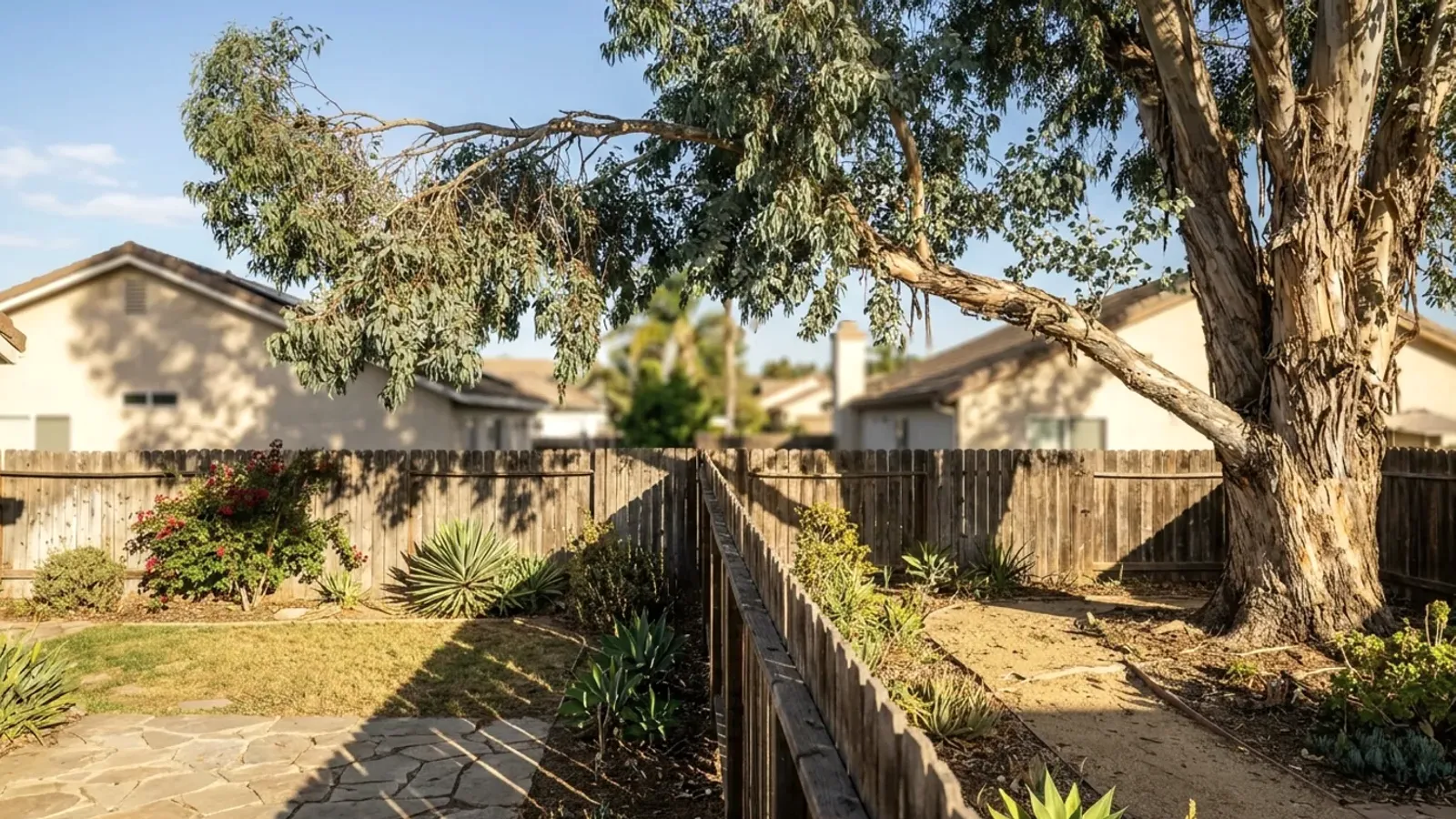
A branch crossing your fence does not become yours to chop. California law assigns ownership based on where the main trunk grows, not where limbs reach. Before anyone cuts wood, verify which lot holds that trunk. Check whether the city or county controls it. Confirm if the planned work requires agency approval.
If the trunk just split, timber is snapping, or people face immediate harm, back away. Dial 911 for injuries or sudden danger. For downed power lines, contact emergency services first, then reach SDG&E at 1-800-411-7343 from a safe distance. Standing wood touching overhead wires belongs to the utility company initially.
Who actually owns a boundary tree
Civil Code section 833 sets the baseline. A trunk growing entirely within one parcel belongs to that landowner. Roots spreading under an adjacent yard change nothing about ownership. Civil Code section 834 addresses shared trunks. When the base straddles both lots, both neighbors share ownership equally.
Fences rarely mark exact legal boundaries. Hire a licensed surveyor to find true markers if the line is unclear. That step might not resolve every legal argument. An arborist evaluates plant health and predicts how specific cuts affect stability. A California attorney interprets rights, while courts settle contested claims. These are distinct roles. The professional we match you with cannot provide legal standing.
Trimming overhanging limbs on your lot
No statewide rule guarantees safety when cutting growth above your own soil. A boundary marker is neither a trimming guide nor liability protection.
Booska v. Patel, decided in 1994, shapes this discussion. One owner severed roots entirely within his own parcel. The appellate court rejected any absolute right to destroy those roots regardless of resulting harm. Reasonableness and ordinary care still govern such actions. The appellate panel overturned summary judgment and returned the matter for trial. It awarded no money. It never ruled those specific cuts lawful. It did not forbid all root pruning.
The real takeaway is narrow. Remaining on your own dirt fails to make every cut legal. Keeping the plant alive is only one concern. Stability, unreasonable harm, physical access, permits, and precise cuts all factor in.
Never climb into an adjacent yard’s canopy. Avoid leaning ladders across dividing fences. Do not dig trenches around roots yourself. Skip running saws while balancing on rungs. If ground-level work is necessary, the professional you hire handles it after legal questions clear. Our page on tree trimming explains what that service covers.
Dealing with roots cracking concrete or slabs
The same restrictions apply underground. Encroaching roots remain the trunk owner’s responsibility. Slicing everything at the boundary often harms the plant. Removing too many anchors can topple mature trees. It also risks injuring property you do not hold title to.
Shared boundary plants add another complication. Joint ownership prevents either neighbor from making destructive cuts alone. Neither party should treat a shared trunk as a solo project.
When hardscape damage is the core issue, start with a condition report rather than digging. Our post on tree roots damaging a foundation outlines what inspectors check before anyone works near structures.
For excavation near utilities, DigAlert serves San Diego County. Phone 811 before using powered equipment underground. Utility locators typically mark lines up to the meter. They miss private irrigation pipes, sewer laterals, and other unrecorded facilities. Those marks show horizontal paths, not depth. Private infrastructure requires separate locating services.
Homeowners get an exception only for manual labor on their own land without permits or machines. Powered equipment or permitted jobs fall outside that carve-out. Qualified excavators handle exposure safely. Leave that digging to them.
Giving notice before starting work
Civil Code section 3502 allows individuals to abate private nuisances. That right carries limits. You must prevent breaches of peace and avoid unnecessary harm. It never authorizes declaring any unwanted plant a nuisance for removal.
Civil Code section 3503 demands reasonable notice under specific conditions. This applies when the problem stems from inaction and fixing it requires entering adjacent land. It establishes no universal written warning mandate for hanging branches. It grants no blanket entry rights onto neighboring parcels.
Discuss proposed scopes with adjacent owners before anyone starts sawing. Shared ownership never creates automatic entry privileges. Actual notice requirements depend on specific facts, local ordinances, and legal counsel.
Liability for harming someone else’s tree
Legal exposure depends heavily on what happened. Damaging another person’s plant can trigger penalties beyond standard repair bills.
Civil Code section 3346 establishes increased financial exposure for unauthorized injury or removal on foreign land. Multipliers shift based on circumstances. Subsection (b) offers a qualified defense when someone relied upon a licensed boundary survey. Accidental cuts do not automatically multiply every bill threefold.
Code of Civil Procedure section 733 authorizes civil lawsuits for unauthorized cutting, girdling, or destruction in listed settings. It provides another path to increased financial exposure. Judges apply it to specific evidence. Courts do not simply stack this multiplier on top of section 3346.
Only a California attorney can apply these statutes to your situation. An ISA credential held by the worker never makes unlawful acts legal. Staying inside your own boundaries fails to guarantee immunity either.
When a neighboring tree falls on your home
Ownership, insurance policies, and legal fault represent three distinct questions.
The California Department of Insurance notes that fallen timber damaging an insured structure generally receives coverage subject to policy language. Ask your carrier which sections address structural repairs, debris hauling, remaining stumps, and replacement planting. Verify named perils, payout limits, and applicable deductibles. Never assume the declarations page tells the whole story. See our related post on does homeowners insurance cover tree removal for more context.
Vehicle damage follows different rules. Auto policies with optional collision waivers or similar endorsements usually handle cars, not homeowners policies.
Healthy wood failing during high winds is not automatically an act of God. Ignoring prior complaints does not always equal negligence. Visible defects fail to determine who pays. Answers rely on plant health, owner knowledge, policy wording, and documented facts. Professional reports inform claims but guarantee nothing. Carriers still evaluate current policies alongside submitted evidence.
Keep your distance from failing plants. Read our guides on signs a tree is dying and leaning trees to learn what to watch safely. If the hazard requires immediate action, our emergency tree service page explains how matched pros respond.
Public rights of way and protected species
Growth crossing a fence might still face legal blocks. Street trees, heritage designations, nesting birds, and recorded easements restrict work even when limbs hang above private soil.
Within the City of San Diego, street tree maintenance, removal, planting, and root pruning require a permit following municipal inspection. City staff evaluate immediate hazards. Other requests follow Council Policy 200-5. That framework excludes most private yards. A contractor showing up early never grants authority to remove municipal property. Report public issues through Get It Done.
Municipal processes vary wildly across the county. Coastal areas like Encinitas enforce different standards than inland spots like El Cajon. Always confirm parcel jurisdiction, public versus private status, and protected designations before scheduling labor. Mailing addresses mislead frequently.
HOA declarations and Civil Code provisions add further restrictions for governed communities. We explore those layers in our piece on HOA tree disputes.
California Department of Fish and Wildlife guidance identifies February through August as typical nesting months for many species. Timelines shift by location and bird type. Active nests can appear outside those windows. Never disturb occupied nests for inspection. Consulting biologists survey vegetation before crews start when birds might be present.
Steps to take before hiring anyone
Work through this sequence before scheduling labor.
Identify the species and gather existing boundary documents. Fences offer clues rather than proof.
Photograph concerns exclusively from safe positions on land you control. Avoid approaching unstable wood, damaged structures, or energized lines.
Share observations and proposed plans with adjacent owners.
Request a condition assessment from a licensed, independent professional. Verify active licenses via the CSLB lookup tool. If you need written documentation, agree on those terms beforehand. Reports do not guarantee insurer acceptance or courtroom victories. Booking an arborist consultation is one way to secure that evaluation. ISA credentials belong to individuals, so ask workers to show theirs. Credentials never resolve the legal questions outlined above.
Resolve permission, public status, and permit requirements with the controlling agency.
Document agreements covering payment responsibility, specific cuts, debris disposal, and site restoration.
Utility conflicts remain an SDG&E matter. If the entire plant poses a hazard, you might need tree removal instead of pruning. Neither option constitutes legal advice. Neither promises a cut exactly at the boundary that preserves plant health. Costs for these services depend on plant size, species, site access, hauling distance, permit fees, and whether cranes are needed. The matched professional quotes the final price before work begins.
Frequently asked questions
Must I notify my neighbor before pruning overhanging growth?
Sometimes, depending on circumstances. Civil Code section 3503 mandates reasonable notice under narrow conditions. This triggers when problems stem from inaction. It also requires that fixing the issue demands entering adjacent land. No universal written warning exists for hanging branches. Entry authorization remains absent. Discuss scope with neighbors first. Consult a California attorney if access becomes contested.
Can I force my neighbor to fund the trimming?
No automatic mechanism shifts costs. Trunk ownership alone fails to transfer bills. Cost allocation, negligence findings, and insurance claims operate separately. Ignored requests generate no invoices. Only a California attorney evaluates recovery options.
Does a boundary plant automatically belong to both lots?
Only when the trunk physically crosses the legal line. Civil Code section 834 defines that scenario as shared ownership. Entirely contained trunks follow section 833, granting full ownership to the hosting parcel regardless of spreading roots or branches. Wooden fences are not surveyed boundaries.
Will my insurance pay if their tree hits my house?
Contact your carrier directly. The California Department of Insurance states that structural damage from falling timber generally receives coverage subject to specific policy language. Deductibles, debris hauling, stump extraction, and replanting depend entirely on your contract. Vehicle damage usually routes through auto policies. Review our breakdown of does homeowners insurance cover tree removal for details.
Could I face an order to remove a plant they dislike?
Preferences regarding views or fallen leaves carry no legal weight. Dislike generates no removal mandates. Hazardous conditions, local codes, HOA covenants, municipal rules, or judicial orders create different obligations. Verify which regulation governs your specific parcel.
Can crews prune exactly to the boundary while preserving health?
Nobody guarantees both outcomes simultaneously. Boundary cuts frequently remove excessive canopy or vital anchors. The professional you hire assesses whether defined scopes make arboricultural sense. Legal precision along a property line rarely aligns with ideal plant care.
This article provides general information rather than legal counsel. Consult a California attorney before anyone operates a saw if disputes already exist.
When to call a tree professional
Hire help when branches threaten structures, roots crack foundations, or ownership disputes stall progress. Professionals assess hazards safely and execute permitted work correctly. Call (858) 400-4587 and Limb SD will connect you with a licensed local tree professional.