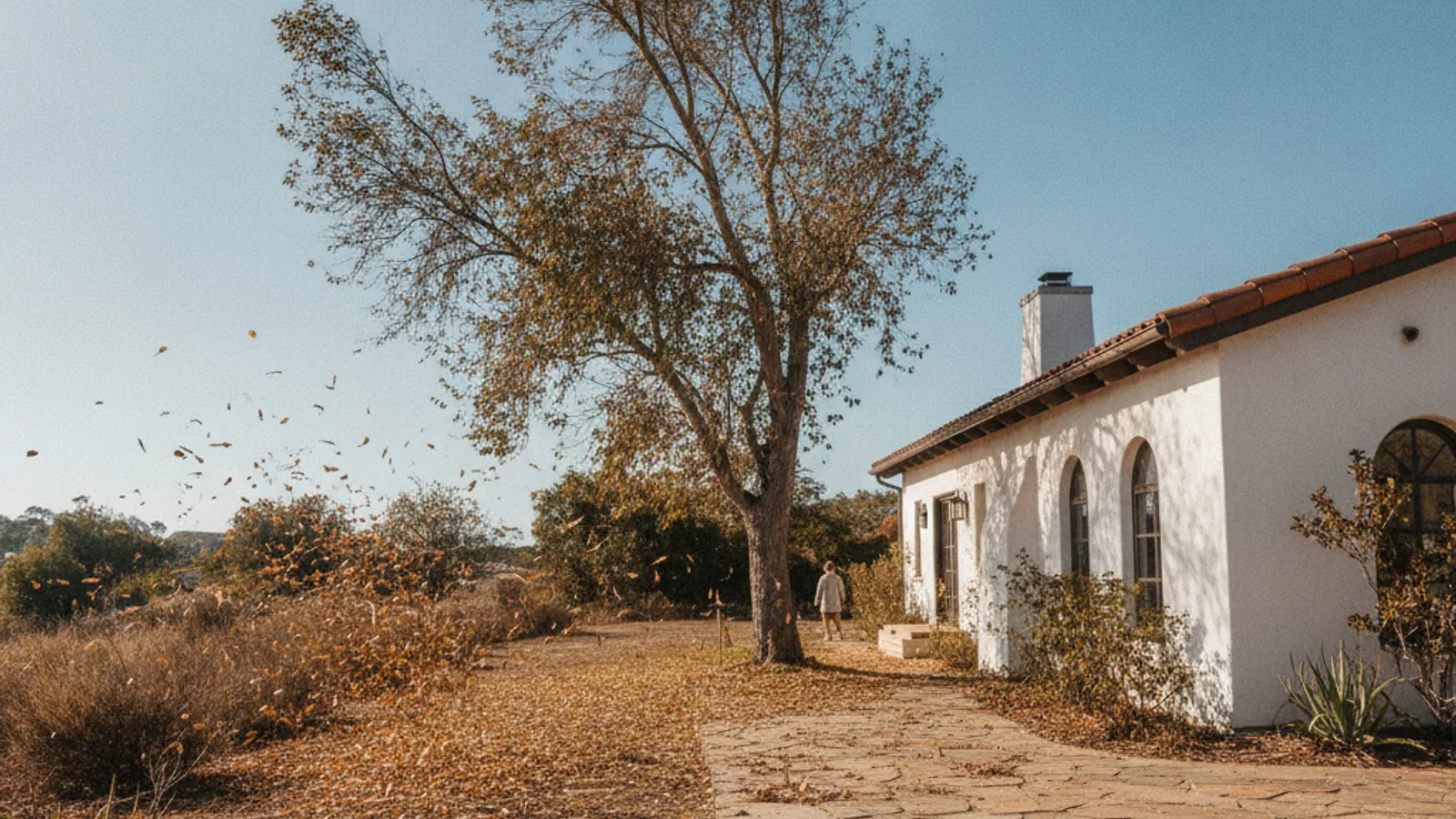
Limb SD connects property owners with licensed and insured independent tree professionals across San Diego County. Limb SD holds no trade licenses and performs no tree work. The customer hires and pays the matched professional directly.
Light, selective thinning by a qualified pro can reduce how hard wind pushes on a big tree. Heavy thinning can make things worse. The International Society of Arboriculture (ISA) says generally no more than 25% of the crown should come off at once, and less for mature trees. Thinning also can’t fix decay, root damage, or a lean.
When do Santa Ana winds hit San Diego?
The National Weather Service’s climate memo for San Diego says Santa Ana winds commonly occur between October and February with December having the highest frequency of events. It adds that summer events are rare. So October is the start, and the main stretch runs through winter.
The same publication describes them as warm, dry winds from the east or northeast. They’re strongest through and below the passes and canyons, and forecasters usually reserve the name for winds greater than 25 knots. That means exposure varies a lot from one lot to the next. Ask your pro how exposed your site is.
Does thinning make a tree safer in wind?
It can, but the research is limited. All three studies below used small trees outside California, so treat them as those studies’ findings, not a rule for a mature San Diego tree.
- Live oaks in Florida. In a hurricane-force wind test on 20 trees about 20 feet tall, “thinning or reducing crowns significantly reduced upper trunk movement at all wind speeds, whereas raising did not.” The test dose was 33% of the foliage, which is above ISA’s general 25% guideline. The study measured trunk movement, not whether trees broke.
- Red maples in North Carolina. In a nursery test of 81 small red maples, the pruning treatments reduced wind load, and “reduction in wind load was linearly related to the amount of weight removed.” The trees were tested at up to 45 mph.
- Another Florida live oak trial. This one tested 0%, 15%, 30% and 45% foliage removal in winds up to 75 mph. More pruning meant less trunk movement. It also concluded that “thinning the outer edge of the crown was one of the least effective pruning types for reducing trunk movement in wind.”
So the honest summary is this. Taking weight and sail out of a crown helps. How you take it out matters. The cut type and the tree both change the result.
Less movement isn’t the same as a safe tree. The first Florida study also found that “lower trunk movement was not affected by pruning type.” Its authors say more research is needed on larger trees and gusty winds.
How much canopy is too much?
ISA’s consumer guide on pruning mature trees says: “Generally, no more than 25% of the crown should be removed at once, and less for mature trees.” It adds that the right amount depends on the tree’s size, species, age, and the pruning goal.
It also warns that “routine thinning does not necessarily improve the health of a tree.” Leaves make the sugar a tree lives on, and heavy pruning “can be a significant health stress.” More isn’t safer. ISA notes that removing foliage “can reduce growth and stored energy reserves.”
That guide also says heavy pruning of live tissue just after the spring growth flush should be avoided. Your pro can tell you how that applies to your species.
What is lion-tailing, and why does it backfire?
Lion-tailing strips the small interior branches off the main limbs and leaves a tuft at the end. It feels like the most wind-proof option because the tree looks airy. It isn’t.
ISA’s tree risk brochure lists poor taper as a defect: “Branches or stems with their weight concentrated near the end are more prone to failure.” That’s the shape lion-tailing creates. In the red maple study, lion-tailing did not lower the height where wind pushes on the crown, even though it removed more foliage than reduction pruning.
The same paper notes the American National Standards Institute A300 pruning standard “recommends two pruning types, thinning and reduction.” Lion-tailing isn’t one of them.
If a quote says to “open it up” by removing all the inner growth, ask which cuts and what percentage. That’s the red flag.
Does it change by species in San Diego?
Yes. Three common local situations come up.
Eucalyptus. Wind is only one way these fail. UC ANR describes summer branch drop as limbs falling on hot, calm afternoons, and names eucalyptus among the affected trees. Its management advice for mature trees is to “shorten and lighten long horizontal branches and open up the tree by thinning to healthy lateral branches to reduce branch weight.” So thinning can help with eucalyptus, but it targets limb weight, not just wind. Our eucalyptus trimming safety guide covers the rest.
Palms. Palms aren’t thinned like broadleaf trees. UF/IFAS Extension in Florida says “giving palms a ‘hurricane cut’ or pruning to a pencil point top actually weakens their ability to withstand high winds.” That’s Florida guidance, so ask your pro how it fits your palm species. Our palm trimming season guide and palm service page cover the local side.
Ficus and other surface-rooted trees. The UC Riverside barrier study calls Indian laurel fig one of two commonly planted landscape tree species observed to develop extensive surface roots. Whether a given ficus is a wind risk depends on its roots and soil, so thinning alone can’t answer that.
Can I schedule thinning around nesting season?
Winter wind prep and bird season mostly don’t collide. The California Department of Fish and Wildlife (CDFW) recommends working outside nesting bird season, “which for many bird species in California is February through August.” It adds that “in some parts of the state, birds nest year-round.”
The same CDFW page notes that Fish and Game Code section 3503 covers unlawful take, possession or needless destruction of nests or eggs of any bird. Our San Diego pruning calendar covers nest surveys. Confirm the rules for your situation with CDFW.
That puts October through January outside the window CDFW names for many species. If you postpone thinning until spring, the nesting question comes back.
What to get in writing from the pro
Ask for a written scope before anyone climbs. Include:
- The pruning type, using ISA’s terms: cleaning, thinning, raising, or reduction.
- The percentage of live crown coming off, with ISA’s 25% ceiling in mind and less for a mature tree.
- Which limbs, marked or listed. Ask for the reason for each cut.
- Cut locations. ISA says cuts should be made just outside the branch collar. For reductions, back to a branch at least one-third the diameter of the cut stem.
- No topping, no lion-tailing, no wound dressing. ISA says research shows dressings “do not reduce decay or speed wound closure.”
- Credentials. ISA offers a “Verify a Credential” tool to confirm an arborist’s ISA credential.
Pricing varies with tree size, access, and the work involved. Compare written scopes, not just totals. The tree pruning and tree trimming pages show what each covers.
When is thinning not the answer?
Thinning reduces load. It doesn’t repair a failing tree.
UC IPM says decay can also be hidden, affecting wood strength without any outward sign. A tree can look full and green and still be weak inside. ISA’s risk brochure lists cracks, cavities, mushrooms at the base, and soil cracks near a leaning tree as signs for an arborist to examine.
Roots matter too. UC IPM says when large roots are cut or injured, the tree becomes more likely to be blown over by wind, especially if the soil is wet. A trenched yard or a graded slope can matter more than the crown.
If you see any of those signs, read is my tree going to fall first. Ask for a risk assessment before a pruning job. The right answer may be support, removal, or leaving the tree alone.
Frequently asked questions
Will thinning stop my tree from falling in a Santa Ana wind?
No pruning job guarantees that. Studies on small trees show thinning can reduce upper trunk movement, but it doesn’t address decay, root damage, or lean. Get a hazard check first if you see warning signs.
How much of the canopy can be removed at once?
ISA says generally no more than 25% of the crown, and less for mature trees. Your pro should state the percentage in writing.
Is a “hurricane cut” good for a palm before wind season?
UF/IFAS Extension in Florida says it weakens a palm’s ability to withstand high winds. Ask your pro how that applies to your palm.
Is thinning in spring a problem?
It can be. CDFW says nesting season for many California bird species is February through August. Fish and Game Code 3503 covers bird nests and eggs. Ask your pro how they handle it.
Who decides which limbs come off?
You and the pro you hire, in writing. Limb SD connects you with local pros and doesn’t prune, inspect, or set prices.
The short version
Thinning before Santa Ana season can help a healthy tree, if it’s selective and within ISA’s general 25% guideline, less for a mature tree. Lion-tailing leaves weight at branch ends, and UF/IFAS warns that palm “hurricane cuts” weaken palms in high wind. A tree with decay, cut roots, or a lean needs an assessment, not a haircut.
When to call a tree professional
Call before the wind season if you have a large tree over the house, or if it has cracks, a new lean, or recent root work. Call (858) 400-4587 and Limb SD will connect you with a licensed local tree professional.