Limb SD connects property owners with licensed and insured independent tree professionals across San Diego County. Limb SD holds no trade licenses and performs no tree work. The customer hires and pays the matched professional directly.
Any tree can fall, but only some give warning first. The International Society of Arboriculture (ISA) puts it this way: all trees have the potential to fall, but only a small number actually hit something or someone. The goal of a ground check is to spot the defects that raise the odds, so you know when to bring in someone trained to measure the risk.
You can safely look at the trunk, the base, the soil and the lower canopy from a distance. You can’t safely judge how much sound wood is left inside a trunk. That second job belongs to an arborist.
Does a crack in the trunk mean the tree will fall?
A crack is a warning sign, not a verdict. Cracks that run into the wood matter most. UC Agriculture and Natural Resources (UC ANR) explains that cracks indicate a separation of wood fibers has occurred and the load-bearing capacity of the branch or trunk is diminished. The same publication says cracks that go completely through a stem or branch, or two or more cracks in the same general area of the stem, are of substantial concern.
ISA’s checklist tells owners to look for longitudinal cracks or splits on the trunk, major branches, or branch unions. Photograph any crack with a coin or ruler beside it. Check again after the next windy day or wet spell to see whether it has widened.
Is a leaning tree about to fall?
It depends on whether the lean is old or new. UC ANR separates the two. A tree that has grown in a non-vertical position and stays there is a corrected lean, often with an upward curve in the trunk. Trees that change position, shift or tilt, have an uncorrected lean, and those are the greater concern.
Look at the soil on the side opposite the lean. UC ANR describes soil plate lifting on the side opposite the lean as a strong indicator that a tree has shifted position. ISA adds that cracks or separations in the soil may indicate soil heaving from excessive movement of the roots, a warning sign for failure especially if the tree is leaning.
Saturated ground matters here. UC ANR notes that the cohesive properties of a soil are reduced under saturated conditions, permitting roots to lift more readily. A lean that appears after a heavy San Diego storm deserves a closer look than one that has been there for decades. Our guide to leaning trees covers whether a lean can be straightened.
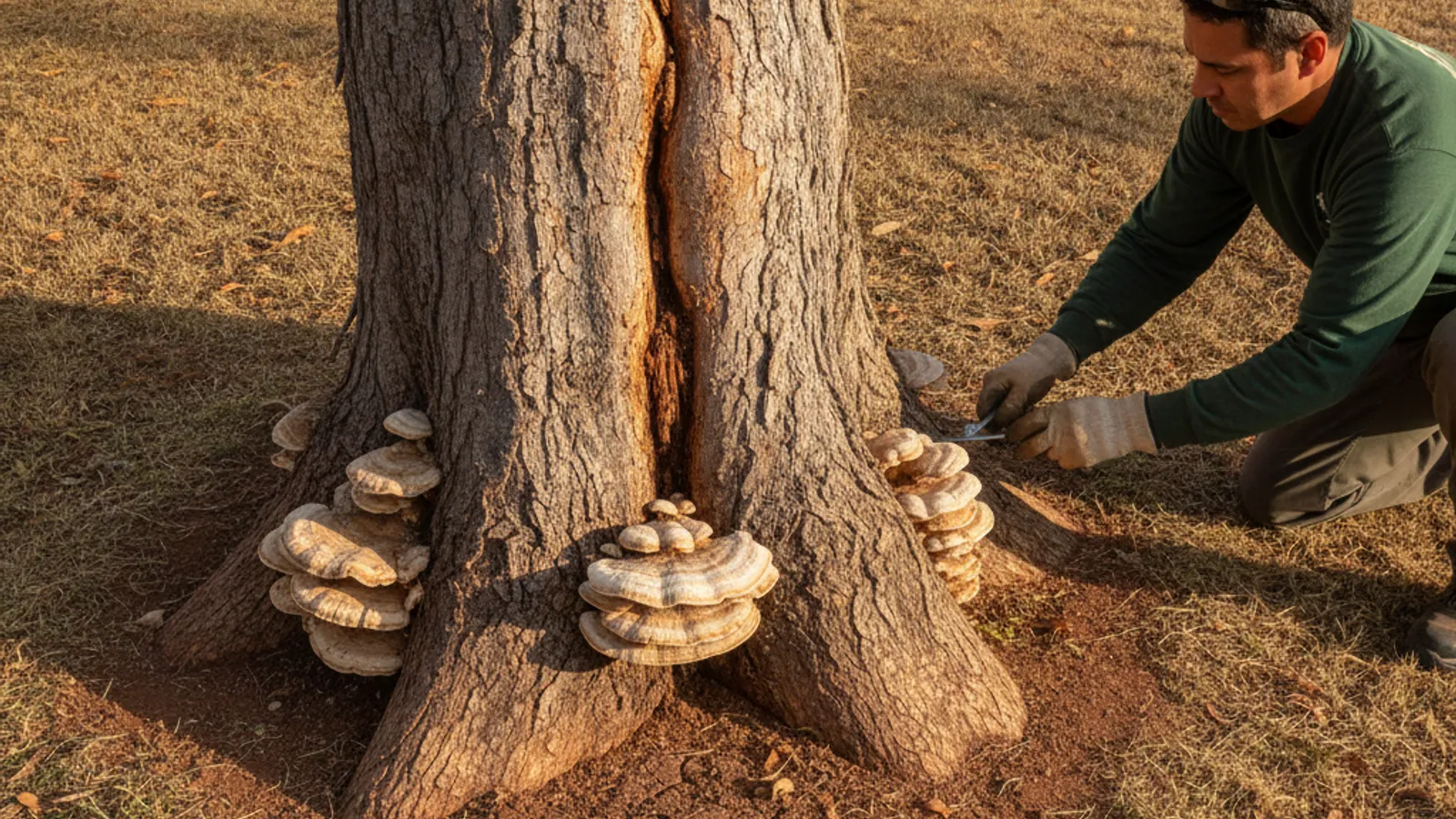
What do mushrooms or conks at the base mean?
Fungal fruiting bodies are a sign of decay that has already progressed. UC IPM states that when a fruiting body is visible on a tree, it is usually associated with advanced decay; the extent of decay may be far above or below the location of the fruiting body. For one common conk, the artist’s conk (Ganoderma applanatum), it adds that conks usually are found near ground level, and columns of decaying wood can extend as far as 15 feet above and below the conk.
Decay costs more strength than you’d expect. UC IPM reports that a 10% loss of wood weight can result in 70 to 90% loss in wood strength. Knocking the mushrooms off doesn’t change what’s happening inside. ISA’s checklist includes the question are mushrooms present at the base of or under the tree? A “yes” is a reason to book an assessment.
What about cavities, split trunks and included bark?
Cavities and rotten wood along the trunk or in major limbs are on ISA’s checklist: are there cavities or rotten wood along the trunk or in major branches? A hollow you can see is only the visible part. How much sound wall remains is the question an arborist answers.
Two trunks growing from one point deserve a look too. ISA says codominant stems can often be failure points. UC ANR explains why: bark may become embedded between stems, limiting the development of attachment wood and reducing the strength of attachment. It adds that codominant stems with a narrow angle of attachment (V-shaped) are more likely to develop included bark than widely separated ones.
From the ground, look at the fork. A tight V with a seam of bark running into it is the pattern to flag.
Are dead or hanging branches after a storm or wind event dangerous?
Yes. Stay out from under them. ISA calls dead branches in the canopy probably the most obvious potential hazards, with the risk depending on the size of the dead branch and distance from any potential targets. A bent or half-torn limb carries stored force. University of Missouri Extension warns that the quick release of that stored energy by cutting with a chain saw can have unpredictable and dangerous results.
Check where the limb sits before anything else.
- Near a power line: ISA says never attempt to remove branches or any tree part from or near power lines, and if you see tree parts in contact with utility lines, call your local electricity provider. In San Diego that’s SDG&E at 1-800-411-7343, the number the City of San Diego gives for trees affecting power lines. SDG&E also warns that fallen electric lines are extremely dangerous. Our trees near power lines guide covers the next steps.
- On a City street tree: The City of San Diego says hazards within the City right-of-way, such as fallen branches or a fallen tree, should be reported to the City, and that City-maintained tree issues should be reported through the Get It Done application. The street tree trimming responsibility guide covers the ownership question.
- On your own property: A large or high limb hanging over a roof, fence or driveway is a job for a professional crew.
Some limbs fail with no storm at all. UC ANR describes sudden branch drop, a summer failure of apparently sound limbs on hot, calm summer afternoons. The publication lists Eucalyptus, Ficus microcarpa and Olea europaea among genera and species reported to experience it, so eucalyptus, ficus and olive trees all appear. For oaks, it counts failures reported to the California Tree Failure Database: valley oak (57%), followed by coast live oak (29%) of the oak reports. Those are shares of reported failures, not a risk rate for any one tree. The takeaway is that a limb that looks sound isn’t proof of safety.
Can trenching or construction near a tree cause it to fall?
It can, and the damage can take years to show. UC IPM says that when large roots are cut or injured, the tree becomes more likely to be blown over by wind, especially if the soil is wet. It also says the adverse effects of construction damage to trees may not become apparent until several years after the injury or stress.
Roots reach farther than most people picture. Per UC IPM, most roots are near the soil surface and many extend much farther than the tree canopy spread. A sprinkler trench, a new pool, or a utility line can cut roots well outside the drip line. UC ANR states that root injury caused by cutting or mechanical damage such as trenching compromises anchorage and can lead to failure.
ISA’s checklist asks whether the area has recently been altered by construction, changes in soil level, or installations of lawns or pavement. If so, tell the arborist. If the tree is a City street tree, don’t cut roots yourself: the City says you may request a No-Fee Permit for trimming, removal, planting or root pruning following inspection by City staff.
How do I tell a dead tree from a dormant one?
Scratch a twig. NC State Extension describes the scratch test this way: by scratching the outer side of the bark you will be able to reveal the second layer, and if it is green, this is a really good sign that there is still hope for your tree. Test several twigs around the crown. One dead twig proves only that twig is dead.
Don’t judge by the crown alone. Use the twig test before deciding, and have an arborist confirm if the result is mixed. Our signs your tree is dying guide covers the wider picture of a declining tree.
Stress can also mean a pest problem. UC IPM says longhorned borers usually attack stressed or damaged plants, leaving vigorous, appropriately watered trees alone, and that limbs can die back on affected eucalyptus. Our eucalyptus dangers guide goes deeper on the species.
What can I check myself, and what needs an arborist?
| You can check from the ground | Needs an arborist’s assessment |
|---|---|
| Whether a lean is new or old, using old photos | How much of a leaning tree’s root system is still holding |
| Soil lifted or cracked opposite a lean | Whether a lift in the soil means imminent failure |
| Mushrooms or conks at the base | How far decay runs up or down the trunk |
| Cracks you can see, and whether they widen | Whether a crack runs through the wood |
| Dead or hanging limbs, from a safe distance | Whether limbs are safe to remove, and how |
| A tight V-shaped fork | Whether a codominant union will hold |
| Recent trenching or grade changes nearby | Root loss after the work |
The limit is deliberate. UC ANR states that tree risk assessment is a challenge and should not be undertaken without adequate training and preparation, even for experienced professionals. ISA says your tree should be examined by an ISA Certified Arborist if you answer yes to anything on its checklist.
What is TRAQ, and should I ask for it?
TRAQ stands for the ISA Tree Risk Assessment Qualification. ISA describes it as a voluntary qualification program designed to train and assess candidates in a specialized field of arboriculture. Qualified professionals are proficient with the fundamentals of limited-visual and basic tree risk assessment and can make reasoned judgments and recommendations for mitigating identified risk.
It’s a credential, not a state license. When a risk question is the reason for the visit, ask whether the arborist holds it. ISA’s tool lets you confirm whether an arborist has an ISA credential, and its directory is designed to help the public easily find and verify ISA-credentialed tree care professionals.
Work on the tree is a separate matter. California’s CSLB says a Tree and Palm contractor plants, maintains, and removes trees and palms. CSLB’s lookup lets you look up a contractor license to verify information, including complaint disclosure.
Whether the tree comes down, gets pruned or cabled is the call of the pro you hire. What moves a quote includes access, height, species and nearby structures. The tree health diagnosis and arborist consultation pages explain what the referral covers.
Frequently asked questions
How can I tell if a tree is about to fall?
Look for a new lean, lifted soil, deep cracks, fungus at the base, large dead limbs, and recent root damage. Any one is a reason for an assessment. Several together raise the urgency.
Is a tree with a lean always dangerous?
No. A lean that has been stable for years, often with a curved trunk, is a corrected lean. A lean that has shifted, especially with soil lifted on the opposite side, is the concerning kind.
Can I knock the mushrooms off the base?
You can, but it doesn’t remove the decay. UC IPM links visible fruiting bodies to advanced decay, so the tree still needs an assessment.
Who do I call about a hanging limb on a City street tree?
Report it through the City of San Diego’s Get It Done application. If a tree is affecting a power line, call SDG&E at 1-800-411-7343. Stay well away from the tree and the line.
Does a dead-looking winter tree need to come down?
Not always. Scratch a few twigs and look for green tissue under the bark. If you’re unsure, have an arborist look before any removal.
Do I need a TRAQ-qualified arborist?
TRAQ is voluntary, not a license. It’s worth asking about when the question is risk. For the work itself, check the contractor’s license on the CSLB site.
The short version
Check the lean, the soil, the base, the trunk, the limbs and any recent digging. A new lean with lifted soil, deep cracks, conks, or trenched roots calls for an ISA-credentialed arborist, ideally one with TRAQ. Stay clear of hanging limbs and power lines.
When to call a tree professional
Call once you’ve seen any warning sign above, or sooner if the tree stands over a home, a driveway or a power line. Call (858) 400-4587 and Limb SD will connect you with a licensed local tree professional.