Limb SD is a referral service. We connect property owners in San Diego County with licensed and insured independent tree professionals. You hire and pay that professional directly. We perform no tree work ourselves.
A single symptom rarely proves a tree is dead. Generic national lists often misapply symptoms here. Our coastal climate, inland heat, and varied soils change how trees decline. Identify the host species first. Then document every observed change. These ten observations help describe the problem, not replace a diagnosis. Record changes over time and restrict access to unstable material. Assess the entire tree and site before deciding on action.
Thinning canopy and leaf loss
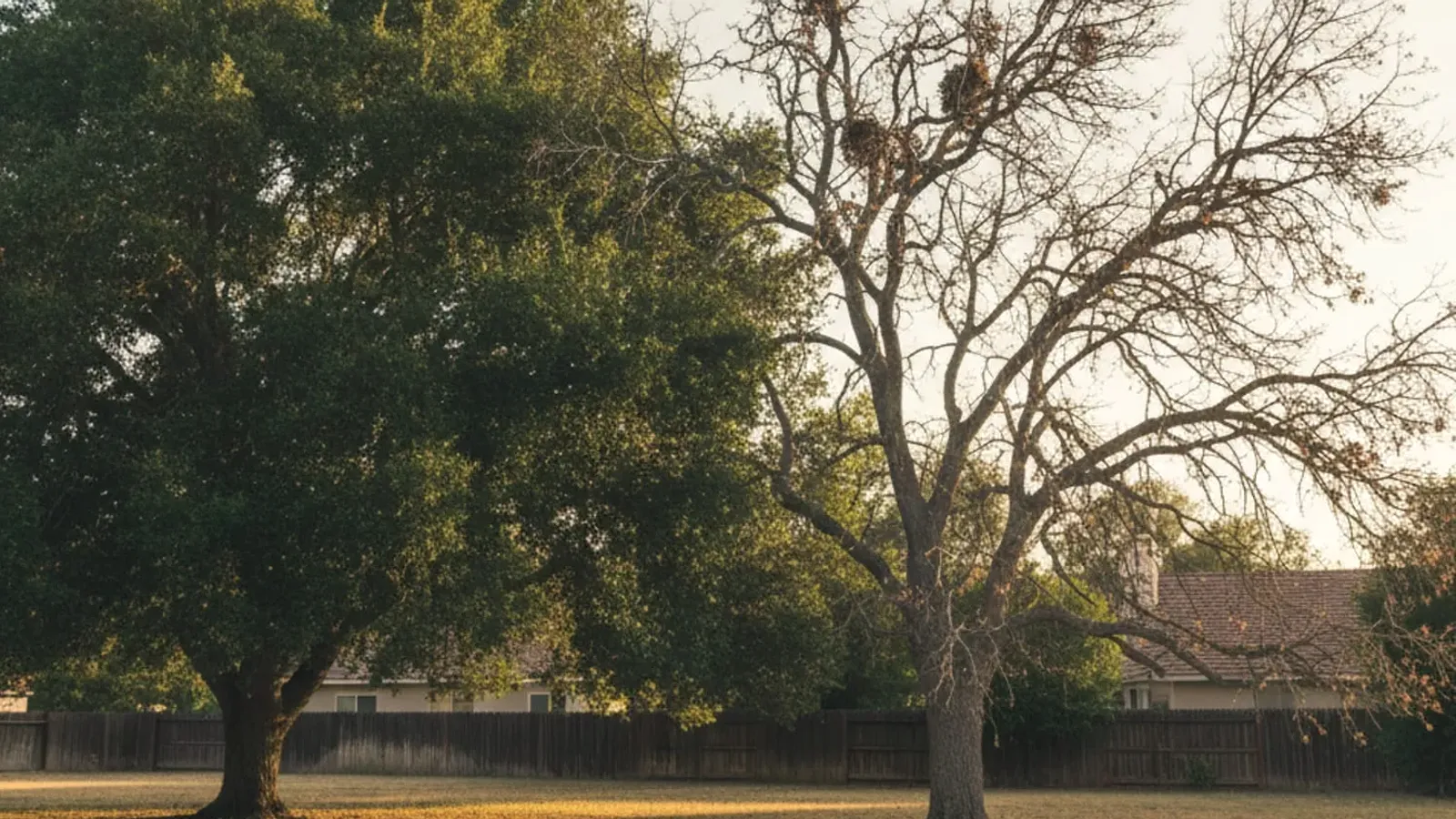
Photograph the full canopy safely from the ground. Note which portion of the crown looks sparse. Compare current images with older ones if you have them. Thinning has multiple causes. It is insufficient alone for a final call. University of California guidance says to evaluate the host and severity together. Do not rely on one symptom. Read more about common San Diego tree diseases to understand local patterns.
Goldspotted oak borer damage
D-shaped holes in the trunk indicate goldspotted oak borer presence. Bark staining and canopy thinning are less specific indicators. Mortality is ongoing across San Diego County per UC maps. Isolated cases exist in Riverside, Orange, Los Angeles, San Bernardino, and Ventura counties. Transporting infested firewood spreads satellite populations. A professional must identify the tree, inspect the trunk, and assess the damage. Photos or hole counts do not constitute a final diagnosis. Review the GSOB FAQ and GSOB Pest Notes for details. Check GSOB distribution maps and management options through the university. If oaks are failing, our network handles tree removal safely.
Other insect activity
Specific insects target specific hosts. Holes alone do not prove hollowness or irrecoverability. Healthy trees survive limited beetle attacks per UC research. Only aggressive beetle species independently cause mortality. Branch-level damage differs significantly from trunk-level damage. Identify the insect, host, affected area, and severity before acting. Avoid pesticides or removal based solely on photos. The university provides detailed information on bark beetles. Pine bark beetles also threaten local conifers. Our guide on the pine bark beetle in San Diego explains what to watch for.
Palm weevil decline
The South American palm weevil is established in San Diego County. This pest damages Canary Island date palms specifically. Severe damage risks crown failure. Identification by a trained eye is still required. Report suspected weevils to the San Diego County agricultural commissioner. Never climb, probe, cut, or move suspect material yourself. Read the university notes on giant palm weevils. You can also review our notes on common palm tree diseases in San Diego. Matched pros offer dedicated palm tree service when intervention is needed.
Root zone and soil problems
Report any recent trenching, paving, grading, traffic, excavation, or fill nearby. Root cutting and compaction cause delayed decline and reduced stability. Large-root injury raises windthrow risk in wet soil. Assess the tree and underground utilities before trenching root barriers. Barriers redirect roots without guaranteeing permanent protection. The university outlines steps for protecting trees during construction. Soil issues near the coast differ from those in East County. Compacted clay in El Cajon behaves differently than sandy soil in Oceanside.
Leaning trunks and soil movement
Stay clear of shifted trees or moving base soil. Photograph the lean safely from a distance. Avoid standing beneath the crown. Note the timing relative to rain, excavation, or impact. Recent movement and old leans require entirely different evaluation methods. A sudden shift after heavy rains demands immediate attention. We cover leaning trees in our piece on how to straighten a leaning tree in San Diego. If the lean threatens a structure, request an emergency tree service through our network.
Cracks and hanging limbs
Document the damage location and whatever sits below it. Exclude people, pets, and vehicles from the affected zone immediately. Never pull, climb, or test damaged limbs yourself. Assessment weighs the defect, overall structure, position, and strike targets. A cracked limb over a driveway is different from one over open space. Proper mitigation often requires tree pruning by someone trained in rigging.
Fungal growths and trunk cavities
Shelves, cavities, and soft wood require professional inspection. Photos cannot quantify remaining sound wood volume inside a trunk. Never strike, drill, scrape, or enlarge suspect areas. Ask the inspector which method supports their recommendation. Internal decay often hides behind healthy-looking bark. An arborist consultation helps determine if the tree can be saved.
Bark loss and open wounds
Document the affected area size and its exact location on the trunk. Do not peel away additional bark to see more. Species, wound history, pests, sun exposure, and construction all matter. Wounds do not automatically mean whole-tree death. A localized injury might compartmentalize well on a mature sycamore but devastate a younger ornamental.
Combining multiple symptoms
Combined issues demand site-specific professional assessment. Multiple symptoms do not mandate automatic removal. Separate health concerns from structural condition and site risk. Treatment, monitoring, pruning, and removal are distinct recommendations. A tree with minor dieback and a cavity might just need monitoring. Another with the same signs plus a root-zone trench might need extraction.
Safety hazards and power lines
Keep people, pets, and vehicles away from unstable trees. Downed lines require you to stay away and call emergency services immediately. Also report downed lines to your local utility provider. Review SDG&E power outage safety guidelines. Utility safety phone: 1-800-411-7343. Never let an untrained person work near conductors.
Insurance coverage basics
Coverage varies by policy. Do not assume all expenses will be paid. The California Department of Insurance notes that home damage is generally covered. Vehicle damage needs optional auto coverage. Confirm deductibles, documentation requirements, and removal allowances with your insurer. Read the CDI storm alert for updated consumer guidance. Providers set their own fees, scope, and availability.
Common questions about declining trees
Scratch tests on one twig ignore roots, trunk health, and site conditions. Beetle holes require context. No universal removal rule applies to every bored trunk. Treatment depends on the pest, species, damage extent, and current guidance. Dead tree removal depends on structure, location, and strike targets. Contact the utility company first if power lines are involved. Verify whether written reports, photos, and follow-up visits are included beforehand. ISA certification is individual and separate from a state contractor license. Request a current digital certificate from the named arborist. Check the ISA credential directory online for verification. A missing directory listing does not disprove active certification.
When to call a tree professional
Call for help when you spot structural cracks, sudden leaning, or rapid canopy loss. Unstable trees near homes, roads, or power lines need trained evaluation right away. Call (858) 400-4587 and Limb SD will connect you with a licensed local tree professional.