Limb SD is a referral service that connects property owners with licensed and insured independent tree professionals across San Diego County. You hire the matched professional directly and pay them for the work. We don’t perform any tree services ourselves.
Two popular palms grow well here, but they behave very differently. Picking between a queen palm vs king palm starts with understanding their shape, how they handle local weather and what kind of upkeep they demand. Coastal breezes in places like Encinitas test these trees differently than the still air of an El Cajon backyard.
Spotting the difference between the two species
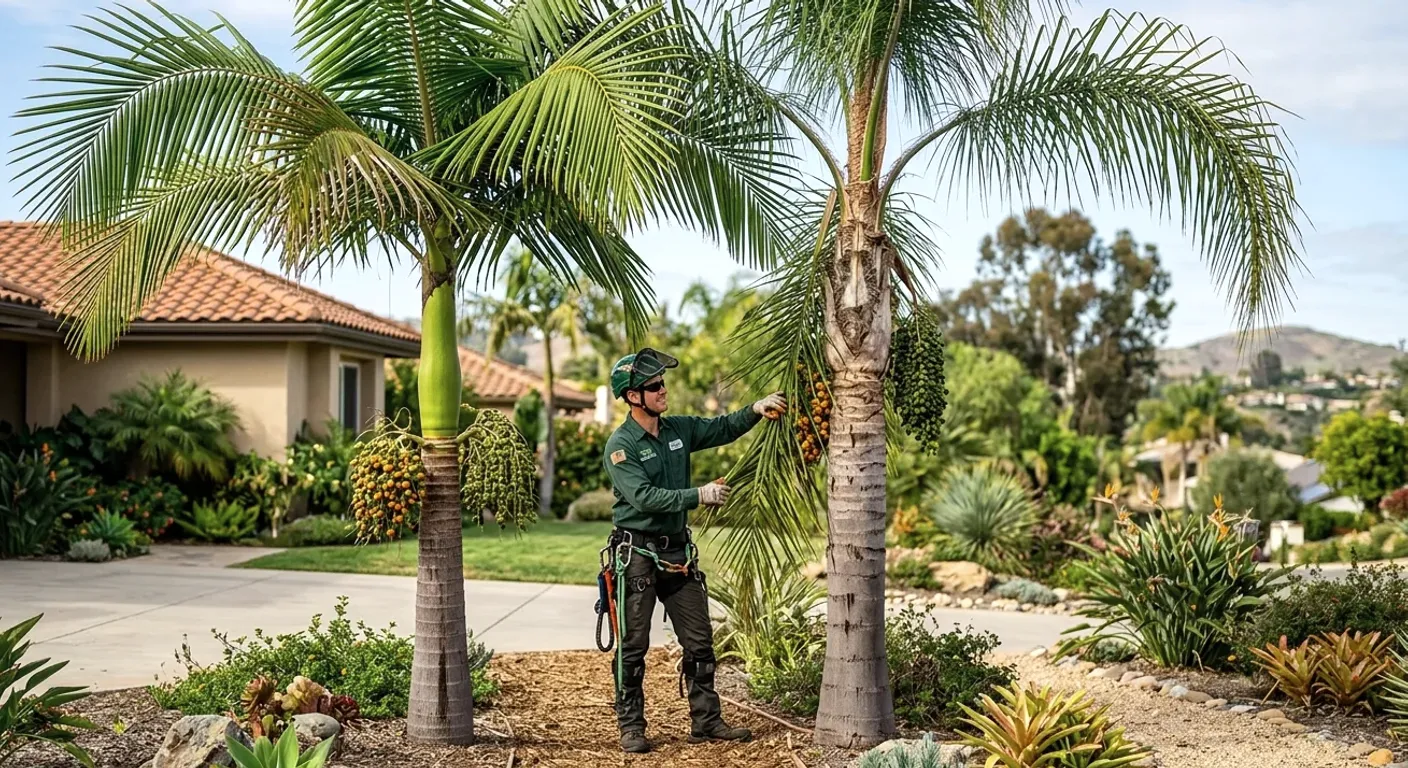
A queen palm carries the botanical name Syagrus romanzoffiana. The USDA queen palm profile describes its smooth gray trunk marked by spaced leaf scars. Its feather leaflets grow in uneven clusters and point every which way. The tips usually hang downward. Mature fruit shows up as yellow or orange orbs. This species lacks a crownshaft entirely.
King palms usually mean Archontophoenix cunninghamiana. They feature a slender ringed trunk topped by a distinct cylinder where leaf bases wrap tightly around the stem. That cylinder, called a crownshaft, ranges from bright green to dull purple or brown. Leaflets stay mostly flat in one plane and remain green on both sides. Check the USDA king palm profile to see those details clearly.
Common names cause mix-ups at nurseries. Another species, Archontophoenix alexandrae, also goes by the king palm label. It has silvery undersides on its leaflets and paler flowers. Always ask for the exact botanical name if your landscape plan only says “king palm.” Our broader guide to palm types found in San Diego yards covers more comparisons. Take photos of the crownshaft, both leaflet surfaces, the full trunk and the entire canopy when identifying a tree. Those angles help the professional you hire give accurate advice.
Matching the palm to your specific yard
Wind exposure decides which species survives long term. A UCCE Southern California palm guide lists both palms for coastal, intermediate and interior valley zones. It adds queen palms to low desert areas but leaves king palms off that list. The same UCCE material calls queen palms wind tolerant while recommending shelter for king palms.
That distinction matters across the county. A queen palm handles open lots near Oceanside far better than a king palm would. A king palm thrives inside a walled courtyard in Rancho Bernardo where buildings block gusts. Look closely at your actual planting spot before buying anything. Note the hours of direct sun, prevailing wind direction, nearby paving and roof overhangs. Check your irrigation setup too. Homeowners anywhere in our San Diego service area can ask the matched professional to evaluate the site first. Have them explain exactly why the location supports the chosen species.
Planning for mature height and canopy spread
Both trees get tall. The UCCE regional guide puts king palms between 30 and 50 feet high with a 20-foot canopy width. Queen palms reach about 50 feet tall but spread roughly 12 feet wide. A separate UF/IFAS queen palm profile describes a 20 to 25-foot canopy spread instead. These numbers are planning guides, not hard limits. Never treat a single chart as your exact setback rule.
Measure the proposed trunk spot against everything around it. Account for rooflines, driveways, pool decks, fences and neighboring property lines. Overhead power lines matter immensely. Never approach electrical conductors to take measurements yourself. Ask the nursery or the professional you hire to draw the expected canopy envelope on your site plan. Leave room for future access so crews can safely reach the crown later. Verify overhead clearance rules and setback requirements with your local planning department and utility provider before digging.
Trimming habits and falling debris
Queen palms hold onto dead fronds. Their heavy orange fruit drops constantly and sprouts unwanted seedlings everywhere. UF/IFAS warns against cutting partly green leaves just because they look spotted. Those older leaves still feed the tree. Read our notes on palm tree trimming season in San Diego to time this work properly.
King palms shed naturally because of their crownshaft. UF/IFAS palm-pruning guidance explains that species with this structure drop old leaves on their own. Falling fronds still pose hazards over roofs, parked cars, walkways and neighbor yards. Neither species follows a universal trimming calendar. The work depends on how much dead material hangs below the canopy and what sits underneath it. Healthy green foliage should stay attached unless a specific clearance issue exists. Climbing spikes leave permanent wounds in palm trunks because that tissue never heals over.
The pros we connect you with through our palm tree service network carry proper licenses and insurance. You approve the scope and pay that company directly. Always verify their current standing and classification using the CSLB license lookup. Pricing depends on tree height, species, site access, hauling distance and whether a crane is needed. The matched professional quotes the job before starting any work.
Recognizing signs that need a closer look
Changes in old leaves or new growth signal trouble, but photos alone cannot diagnose the problem. Write down which fronds changed first and whether the newest spear looks affected. Check the trunk and crown area for visible damage or oozing spots. Keep people away from the base if loose material hangs over a path or driveway.
A local professional can inspect the tree in person. They will determine if the issue stems from poor site conditions, past pruning damage, pests or something else. Our guide to common palm tree diseases in San Diego outlines several symptoms worth tracking. For a formal evaluation, request a match through our tree health diagnosis referral page.
If you want an ISA credentialed arborist involved, ask who will actually climb or inspect the palm. That certification belongs to an individual, not a business entity. It also differs entirely from a California contractor license. You can search for a named person in the ISA credential directory. A missing directory entry does not automatically disprove certification, so ask the individual to show their digital certificate.
When to call a tree professional
Hire a professional when you need help identifying a palm, assessing declining fronds or planning safe removal near structures. Attempting tall canopy work without training risks property damage and serious injury. Call (858) 400-4587 and Limb SD will connect you with a licensed local tree professional.