Uneven browning on a Canary Island date palm needs a closer look, not a quick verdict. Fusarium wilt is one possibility, but several palm problems can appear similar from the ground. The next step is documenting the changes and arranging an on-site diagnosis.
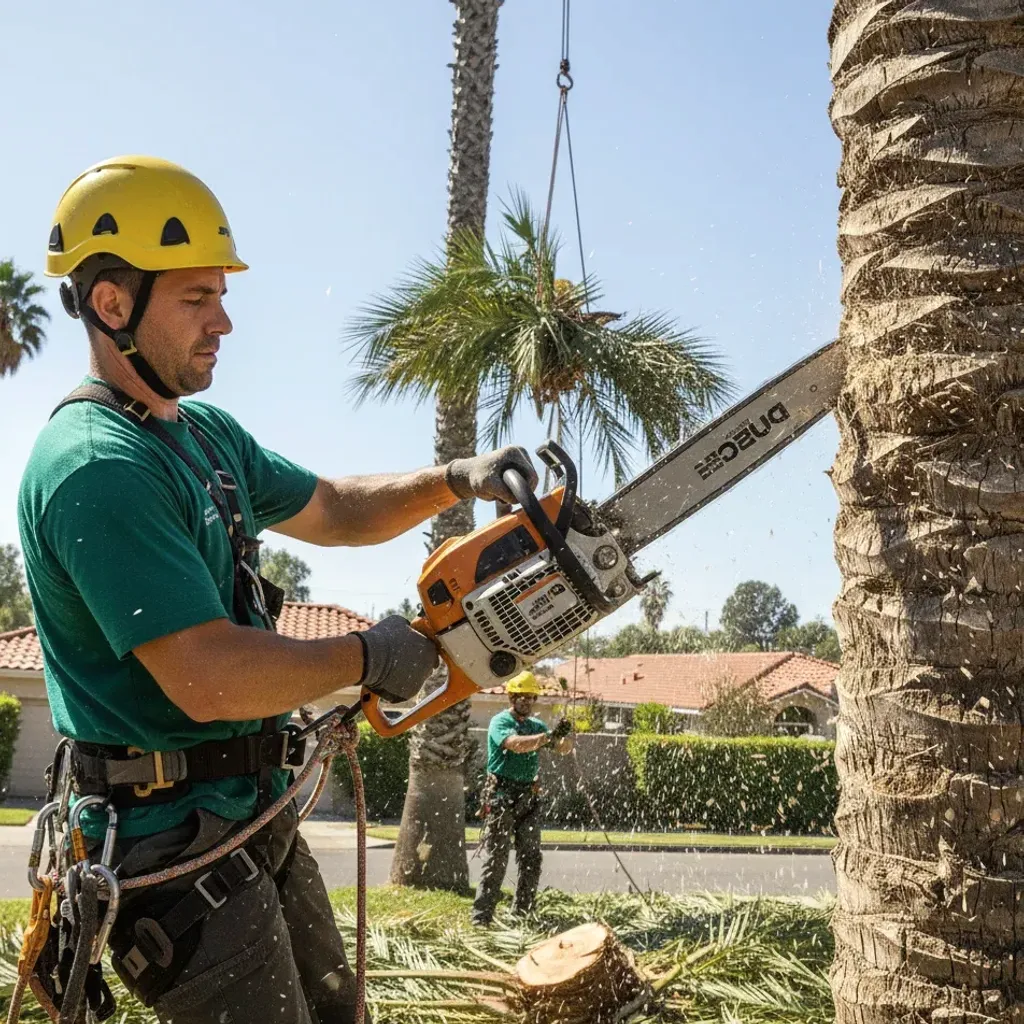
What visible changes deserve a closer inspection
Start with the palm’s full crown. Stand well away from falling fronds, traffic, power lines, and the trunk’s drop zone. Don’t climb the palm or pull declining foliage apart.
Look for changes that differ across the crown. One-sided leaflet death can appear with Fusarium wilt in Canary Island date palms. It can also occur with other palm diseases, so treat it as an inspection clue rather than proof.
From a safe position, record:
- Which fronds show yellow, brown, or dead leaflets
- Whether the damage appears on one side of a frond
- Whether several fronds are involved
- Whether the crown looks uneven
- Whether the growing point appears damaged or displaced
- Whether material is falling from the crown
- Whether the lower trunk has wounds, cavities, or fungal growth
Take photographs from the same location over time. Include one full-crown view and closer ground-level views. Don’t cut a sample before speaking with the person who’ll inspect it. Cutting can erase useful evidence and create another wound.
A palm that remains green can still have concealed structural trouble. UC IPM notes that sudden crown drop can occur despite a green canopy. Visible color is therefore only one part of the assessment.
South American palm weevil is another serious San Diego concern. It’s established in San Diego County and kills Canary Island date palms. Suspected giant palm weevils should be reported to the county agricultural commissioner. Our guide to common palm tree diseases in San Diego explains several other problems that can resemble wilt or general decline.
Why symptoms alone can’t confirm the cause
A declining palm doesn’t identify its own disease. Yellowing, dead leaflets, crown thinning, and uneven decline can share several causes. Site stress and separate structural problems may also appear beside a disease.
Fusarium wilt of Canary Island date palms is caused by Fusarium oxysporum f. sp. canariensis. UC IPM describes it as a lethal vascular wilt with no established cure. That makes an accurate diagnosis important before anyone recommends removal or treats another condition.
One-sided leaflet death isn’t exclusive to Fusarium wilt. UC IPM also lists pink rot and petiole or rachis blights among possible causes of similar symptoms. Fusarium generally involves more leaves, while those blights generally involve fewer. That distinction can guide an inspection, but it can’t confirm the cause by itself.
Other palm problems create different clues. Pink rot often affects stressed or wounded palms. Ganoderma butt rot affects the lower trunk, but a visible conk may be absent. Sudden crown drop concerns hidden trunk failure and may occur beneath a green crown. South American palm weevil damage can involve inaccessible crown tissue.
These differences matter because the response isn’t interchangeable. A pruning plan, disease-management plan, risk assessment, or removal discussion answers a different problem. Remote photographs may help with triage, but they don’t expose the internal tissue or confirm the organism.
Avoid describing the palm as “confirmed Fusarium” when requesting quotes. Instead, list what you observed and ask for tree health diagnosis and treatment before agreeing to irreversible work.
How arborists separate wilt from other palm problems
A useful inspection begins with identity. Canary Island date palms have massive single trunks, feather-shaped leaves, basal leaflets modified into spines, and no crownshaft. Phoenix palms can hybridize, so appearance may not settle every specimen.
The arborist should then connect the symptoms to their location. Crown condition, the number of affected fronds, one-sided leaflet death, old pruning wounds, lower-trunk changes, and recent site disturbance all add context. No single clue should carry the entire diagnosis.
Ask the person inspecting the palm to explain:
- Which species they believe it is
- Which observations support Fusarium wilt
- Which competing causes remain possible
- Whether further diagnostic work is needed
- Whether the concern is disease, structural risk, or both
- What written scope is included with the visit
- What should happen before another palm is pruned
Credentials also need precise verification. ISA certification belongs to an individual, not a company. It’s separate from a California contractor license. The ISA arborist resources explain how individual credentials can be checked, although an absent directory listing alone doesn’t disprove certification.
For paid tree work, check the independent provider through the CSLB license lookup. Current C-49 and valid legacy C-61/D-49 classifications may apply to tree work. Confirm the provider’s current classification, status, insurance, and proposed scope before signing.
Limb SD can match homeowners with licensed, independent local professionals. The customer contracts with and pays that tree company directly. Diagnosis, pruning, removal, cleanup, and any report should each appear clearly in the provider’s written proposal.
What to avoid before a diagnosis
Don’t prune declining fronds merely to make the palm look even. Removing evidence can complicate diagnosis, while unnecessary cuts create wounds. A fixed trimming calendar also doesn’t answer an active disease concern.
Fusarium can spread through contaminated pruning tools and sawdust. Before anyone works on a suspect Canary Island date palm, ask how tools will be physically cleaned and disinfected before they touch another palm. Don’t accept a vague promise that equipment is “usually clean.”
Avoid these steps while the cause remains uncertain:
- Cutting into the trunk to inspect it
- Climbing into a weakened crown
- Pulling loose material from overhead
- Skinning or sculpting the trunk
- Removing healthy foliage without a defined purpose
- Applying an unnamed pesticide
- Moving suspect debris as ordinary yard waste
- Treating a green crown as proof of structural safety
A pesticide proposal needs its own verification. A tree contractor license or ISA credential doesn’t replace the California credentials required for regulated pesticide work. The proposal should identify the product, target problem, application method, precautions, and qualified business or applicator.
Don’t assume spraying can cure Fusarium wilt. UC IPM reports no cure for Fusarium wilt in Canary Island date palms. Treatment claims for a different palm problem don’t change that finding.
Routine palm care should protect healthy foliage and the terminal bud. Climbing spikes permanently wound living palm trunks, and those wounds don’t close. Our guide to pruning a palm tree in San Diego explains why dead-frond removal, living foliage, disease sanitation, and safe access require separate decisions.
When removal may enter the discussion
Removal becomes a reasonable discussion when diagnosis identifies lethal Fusarium wilt or when the palm presents unacceptable structural risk. Those are related decisions, but they aren’t identical. A diseased palm may need a handling plan, while an unstable palm may require immediate safety controls around the target area.
Ask the inspecting professional to separate four points:
- What diagnosis is supported
- What uncertainty remains
- What could fall or be struck
- What removal and debris scope is proposed
The written proposal should identify the exact palm, access route, nearby structures, overhead conflicts, debris handling, stump scope, and final site condition. If equipment must cross landscaping or occupy shared space, settle that access before work begins.
Permits and approvals depend on the palm’s actual location and jurisdiction. A San Diego mailing address doesn’t answer whether the tree stands on private land, public right-of-way, an easement, or property controlled by an association. Confirm those facts with the applicable city, county, property manager, or other authority before authorizing removal.
Power-line conflicts change the order of operations. Keep away from any downed line and contact emergency services and the utility from a safe location. An ordinary tree license doesn’t establish electrical line-clearance qualifications.
For disease-related work, ask how the provider will prevent contaminated tools or material from contacting other palms. Don’t move suspect material between properties without an appropriate handling plan. The palm tree service page outlines the types of palm work an independent provider may assess, including pruning and removal. Confirm the exact scope with that company before hiring.
When to call us
Call when a Canary Island date palm shows uneven frond decline, possible disease, falling material, or concerning crown changes that need professional assessment. Call us at (858) 400-4587 and we’ll connect you with a licensed local tree company.