Limb SD connects property owners with licensed and insured independent tree professionals across San Diego County. Limb SD holds no trade licenses and performs no tree work. The customer hires and pays the matched professional directly.
Roof rats are the most common rat in San Diego County, and they’re the climbing kind. Trimming a palm removes some of their cover, and it keeps the crown from touching your roof. It doesn’t remove the rats. Trapping and baiting are pest control work, a separate trade from tree care.
Why roof rats nest in palms
The County of San Diego says roof rats are the most common type of rat in the county, and that they like to climb rather than burrow. They live above ground.
UC IPM adds that roof rats usually live and nest above ground in shrubs, trees, or dense vegetation. A palm with a thick skirt of dead fronds is dense, elevated cover of exactly that kind, so it’s a reasonable place to check.
Food matters as much as shelter. The County lists human food, pet food, bird seed, and trash among what rats eat. Anything like that left near a palm adds to the draw.
Signs that rats are using a palm
You don’t have to see a rat. The County’s list of signs of rat activity includes piles of gnawed fruit, nuts, or empty snail shells, droppings, rub marks from greasy fur, and sounds in the attic or walls.
UC IPM points to a pattern you can watch for at dusk: rats traveling along utility lines or on fence tops. A palm near a fence line or an overhead wire could sit on that route.
Look under the palm and along the fence for chewed fruit and droppings. Don’t climb into the crown yourself.
What frond and seed-stalk removal does
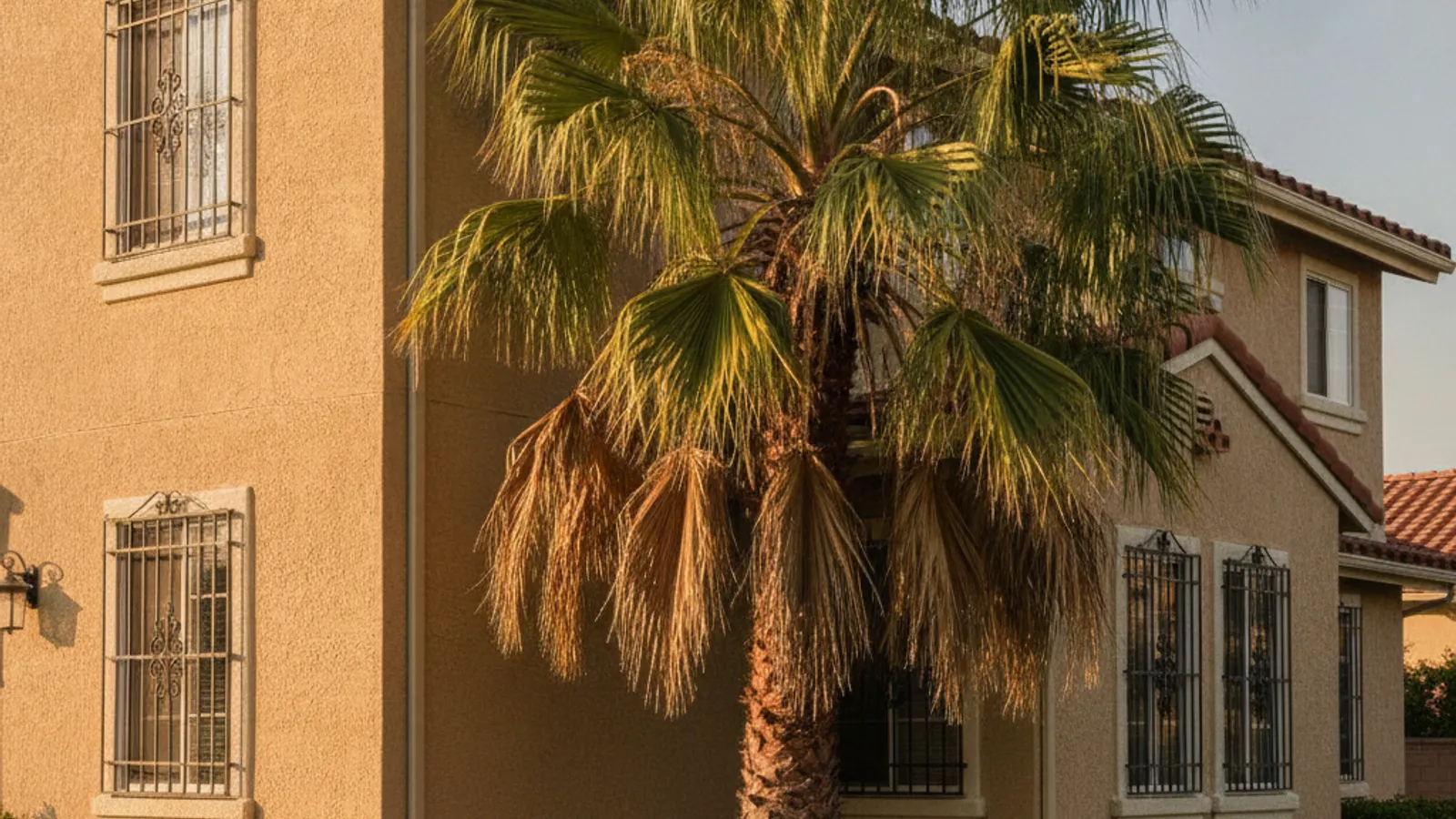
Removing dead fronds and spent seed stalks can take away hiding places. The County’s advice to remove rat habitat includes thinning vegetation to let daylight in, which is the same idea applied to a crown.
Be realistic about it. Cleaning a palm makes the tree less attractive. It doesn’t make the yard rat-free if food, ivy, woodpiles, or gaps in the house are still available. UC IPM says rat management rests on removing food and shelter, trapping, and reducing entry points into buildings.
If you hire a pro for a palm cleaning, tell them rats are the reason. They can plan the work so the crown is cleaned in one visit and any trapping happens separately.
Keep palms away from the roof, fences, and lines
The County recommends trimming trees, bushes, and vines to at least 4 feet away from the roof as part of rat control. UC IPM gives a slightly shorter figure: prune tree limbs that are within 3 feet of a roof. The County’s number is the safer one to plan around.
The County also advises removing heavy vegetation such as ivy, bougainvillea, and pyracantha from buildings and fences. Those plants give rats a second path to the same roof.
Fronds near overhead wires are a different job. Don’t trim near service lines yourself. See trees near power lines in San Diego for who handles what.
The over-trimming tradeoff
Take only what’s dead, spent, or in the way of the roof. The palm pruning guide explains where that line sits, and palm trimming season covers timing.
Rats aren’t the only animals in that skirt. The San Diego Humane Society says at least nine of San Diego’s 23 insect-eating bat species sleep beneath dried palm fronds during the day. It adds that these bats use the frond skirts as maternity roosts in summer, and asks people to wait until after September 1st so pups can fly away safely.
Nesting birds and the law
Active bird nests are protected. The Humane Society notes that birds and active nests are protected from harm or harassment by the Federal Migratory Bird Treaty Act. It also says most songbird nests are small and camouflaged, so trimmers may not see them until too late.
The U.S. Fish and Wildlife Service describes the act as one that prohibits the take of protected migratory bird species without prior authorization. Ask any crew how it checks a crown for nests before cutting. If you aren’t sure about a specific tree, confirm with the agency rather than guessing.
What the County does, and doesn’t do
The County’s Vector Control Program offers educational rodent inspections free to County residents, with a Rat Control Starter Kit and instructions. Its page gives 858-694-2888 and [email protected] for questions.
It has limits. The program is not a pest control company and does not trap, bait, or remove rodents as part of the inspection, and doesn’t provide poison bait. So the County can tell you what to fix, and the trapping falls to you or a pest control company.
Trapping and bait
UC IPM calls snap traps the safest, most effective, and most economical way to trap rats. For roof rats it suggests off-the-ground spots such as ledges, branches, fences, and pipes, out of reach of children and pets.
Poison is restricted. UC IPM states that in California there is currently a prohibition on most uses of second- and first-generation anticoagulant rodenticides, and that professional pest control operators can obtain more types of rodenticides, some of which are restricted-use pesticides. UC IPM also warns that exposure to even a single dead rodent might be enough to poison a pet when second-generation baits are in use.
That’s why the roles split. The tree crew trims and cleans the palm. Traps, bait, and sealing entry points on the house are pest control and home-repair work, so ask a licensed pest control company how it handles them and when the trim should happen.
Frequently asked questions
Do rats live in palm trees in San Diego?
Yes, they can. Roof rats are the most common rat in the county, and UC IPM says they nest above ground in trees and dense vegetation. A palm crown with heavy dead growth fits that description.
Will trimming my palm get rid of the rats?
No. It removes some cover, and it can pull the crown back from your roof. UC IPM’s approach also needs food removal, trapping, and sealing entry points.
How far should palm fronds be from my roof?
The County says at least 4 feet. UC IPM says to prune limbs within 3 feet of a roof. For fronds near a roof, plan around the larger distance.
Can I trim my palms in summer if rats are the problem?
Wait if you can. Dried frond skirts can hold bat pups in summer, and active bird nests are protected. For an urgent roof-contact problem, tell the pro about the rats and ask how they’ll check the crown first.
Does the County remove rats from my yard?
No. Its inspection is educational and free to residents. The program doesn’t trap, bait, or remove rodents.
Who puts out bait?
UC IPM says professional pest control operators can obtain more types of rodenticides than the general public can. Ask a licensed pest control company what it uses and why.
The short version
Roof rats nest in dense, elevated cover, and a neglected palm can be exactly that. Clean the crown, keep fronds off the roof, fences, and lines, and don’t over-trim. Mind the bats and nesting birds. Then use traps and seal entry points, or call a pest control company.
When to call a tree professional
Call when a palm needs cleaning, or its fronds touch the roof, and rats are part of the reason. Call (858) 400-4587 and Limb SD will connect you with a licensed local tree professional. Pest control is a separate call.