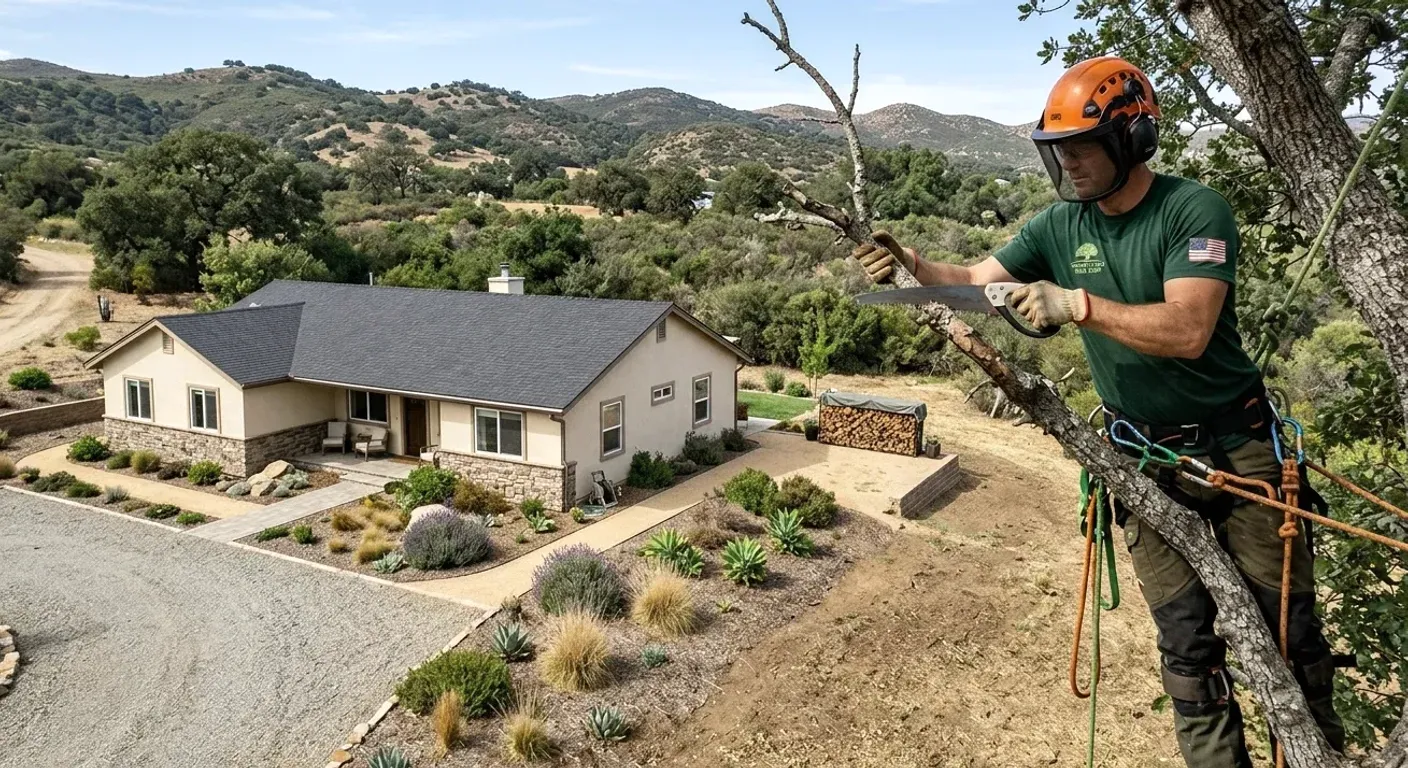
Limb SD is a referral service. We connect property owners across San Diego County with licensed and insured independent tree professionals. You hire and pay that professional directly. We do not perform any tree work ourselves.
Wildfire preparation begins at your property line. Every parcel sits under a specific fire authority and a mapped hazard zone. The rules change between coastal canyons, inland valleys, and mountain slopes. A plan that works in Ramona might violate ordinances in La Jolla. Start by confirming who governs your address. Then walk your yard, identify the exact cuts needed, and figure out where the wood goes. Check those same rules again once the job wraps up.
Downed power lines demand immediate distance. Call 911 and SDG&E at 1-800-411-7343 from a safe spot. Report every downed wire even if it looks dead. If a branch rests against an overhead line, contact SDG&E before anyone approaches the tree. Read their downed-power-line guidance for specifics. Never climb onto a roof or reach into gutters to clear storm debris. Keep both feet on the ground.
Finding your local fire authority
Your mailing address does not determine your fire jurisdiction. Rancho Bernardo falls within the City of San Diego, so City Fire-Rescue sets the rules there. Poway operates its own department and maintains a separate fire-hazard-severity-zone map. Unincorporated areas answer to county planning departments and local fire districts. Water bills and nearby stations do not define your permitting path.
Determine whether the tree stands on private land, inside an easement, along a right-of-way, or on public property. Street trees follow municipal inspection and permit routes. Hiring a crew does not grant you legal authority to cut city property. For street trees managed by the city, review the guidelines at sandiego.gov/trees/maintenance.
Understanding defensible space zones
Ask your fire department which map and statute applies to your lot. California PRC 4291 establishes the 100-foot defensible-space requirement for State Responsibility Areas. Government Code 51182 addresses existing structures inside locally designated Very High Fire Hazard Severity Zones.
Both regulations stop at your property boundary unless a neighbor provides written permission to cross it. Recorded easements and open-space conditions still bind you. The City of San Diego’s defensible-space guide reminds owners to verify easements and MHPA boundaries before touching vegetation on city land.
CAL FIRE outlines these distances on their Ready for Wildfire page. Zone 1 covers the area within 30 feet of buildings or up to the property line. Zone 2 extends from 30 to 100 feet. The Board of Forestry zone page defines Zone 1 as starting five feet out after Zone 0. Always check your local department’s current handout for your specific address.
Zone 0 covers the first five feet around a structure. Ready for Wildfire calls this the ember-resistant zone and notes it is not yet required statewide. The Board of Forestry approved a final draft on August 19, 2026. That package still required OAL review and state filing. As of September 5, 2026, OAL listed the Zone 0 filing as under review. Verify the current status and any local start date with your fire authority. Local rules remain active while state filings are pending.
The City of San Diego currently permits maintained trees within those first five feet. This applies only to city parcels. It does not excuse leaving dead litter, stacked firewood, or flagged hazard trees near your home.
Spacing requirements shift based on slope and vegetation density. Follow your fire authority’s written standard for your address. A qualified professional can also apply that standard during a site visit. Read more about defensible space tree requirements in San Diego for deeper context.
Evaluating vegetation condition over species
Walk the areas you can safely access on foot. Look for dead needles, hanging broken branches, and shrubs growing into lower limbs. Measure the distance between foliage and your walls, decks, or vents. A tree’s physical condition matters far more than its name.
A thick, unpruned canopy leaning over your roof creates a different risk than a well-maintained tree fifty feet away. Removing dead material and breaking up ladder fuel is the actual goal when your fire authority requires it.
Schedule the work based on current fire weather, the tree’s health, and written objectives from your fire department. Hazardous deadwood needs attention in any season. Cosmetic thinning does not satisfy fire clearance mandates.
Active bird nests change the timeline. CDFW notes that February through August is typical nesting season for many species, though birds nest at other times too. This is guidance rather than a permit exemption. A consulting biologist can survey the site and establish a buffer around the nest. Otherwise, delay the work until the birds leave. Never relocate a nest yourself.
Planning the right cuts
Define the objective before any saw starts. Write down exactly what needs removing: specific deadwood, a reduction to a lateral branch, or a clearance mandated by the fire authority. Protect the branch collar on every cut. Avoid flush cuts, trunk skinning, or raising every crown as a default habit.
ISA’s mature-tree pruning brochure suggests keeping removals around 25 percent of live foliage as a general upper limit. Older trees tolerate even less. This is not an annual quota for fire prep. Elevated work, large cuts, and chainsaws belong with trained professionals. Stripping the interior of a canopy does not make a tree fireproof.
Topping a tree leaves stubs that sprout weakly attached growth, according to ISA’s topping brochure. Plan a proper reduction or follow a written clearance order instead.
For larger properties needing broader brush management, look into land clearing. Every clearing project must still respect parcel boundaries, easements, and fire district limits. If you need help deciding what a tree needs, request an arborist consultation through our network.
Handling debris responsibly
Leaving cut branches inside your cleared zone defeats the purpose. Ask the matched professional to specify hauling or placement in their written quote. Clarify who handles disposal based on your zone. Collection rules vary by city. Never assume a county green bin, a municipal drop-off site, or a chip-in-place strategy will accept your specific load.
Keep wood chips away from your foundation. Wet chips still burn. If chips remain on your property, agree on the exact location, depth, and responsibility beforehand.
Burning cuttings at home is rarely a simple option. The San Diego County Air Pollution Control District explains that local fire authorities issue burn permits for specific locations, materials, and quantities. The district itself does not issue them. Good air quality does not equal burning permission. In San Miguel Fire & Rescue’s jurisdiction, permitted burning has been suspended effective May 1, 2026. Verify your own district’s status before planning any burn.
If heavy branches threaten your roof or driveway, the pros we connect you with can provide emergency tree service. For routine maintenance to keep your canopy healthy and safe, schedule regular tree trimming.
Verifying the finished work
Stand on your property and recheck the zones you just addressed. Confirm the deadwood you requested removed is actually gone. Verify the agreed-upon hauling happened. Stay off neighboring land unless you hold written consent or an easement. If the fire department mandated a specific clearance, ask them to confirm the result meets their standard. Request a written report from the professional before they leave if you need documentation.
Verify the credentials of any professional you hire. Check for a C-49 license or a valid legacy C-61/D-49 classification using the CSLB license search. ISA certification belongs to individual arborists, not to Limb SD.
Frequently asked questions
Must I clear all plants from the first five feet?
No statewide rule currently demands total removal. The City of San Diego’s guide permits maintained trees in that space. Verify your specific address with your fire authority. You should still clear dead leaves and stored combustibles from ground level.
Is Zone 0 legally enforced in San Diego County today?
The Board of Forestry approved a final draft on August 19, 2026. As of September 5, 2026, OAL listed that package as under review. Ask your local fire department which rule governs your parcel right now. Some local standards may already exceed state drafts.
How high should I raise my tree canopies?
Ready for Wildfire bases spacing requirements on slope and vegetation type. Follow your fire authority’s written instructions for your lot. A qualified professional can measure and apply those standards during a site visit.
Am I allowed to burn my yard waste?
Never rely on burning as your primary disposal method. Local fire authorities control burn permits, and several districts have suspended them entirely. Specify a hauler and destination in your quote instead.
What if a tree touches a power line?
Stay far away from downed lines. Call 911 and SDG&E at 1-800-411-7343 from a safe distance. Contact SDG&E first if a standing tree leans into overhead wires. Call 911 immediately for injuries or imminent danger.
When to call a tree professional
Fire clearance near structures, power lines, or steep slopes requires trained hands and proper equipment. If your fire authority issues a written mandate, a qualified crew ensures the cuts meet legal standards without damaging the tree. Call (858) 400-4587 and Limb SD will connect you with a licensed local tree professional.