Limb SD is a referral service. We connect property owners across San Diego County with licensed, insured independent tree professionals. The matched pro inspects the tree, sets the scope, and gives a written quote. The customer hires and pays that pro directly.
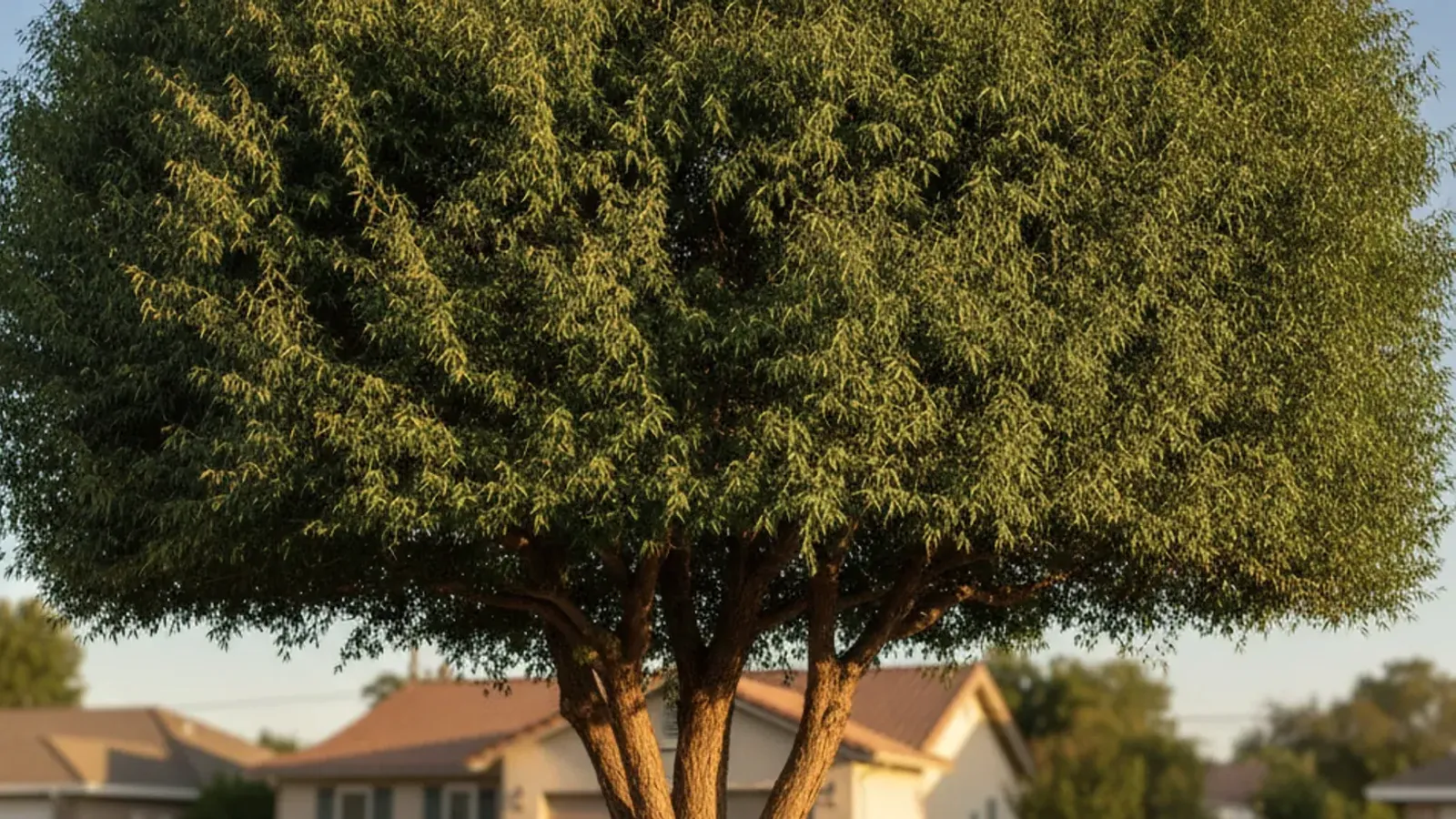
A mature African sumac tree in a San Diego yard often looks settled and benign. That look can hide real defects. The species, the site, and how the tree was raised all change what it needs. A trained eye on the actual tree beats any rule of thumb.
How to tell if your tree is an African sumac
African sumac now goes by Searsia lancea. Rhus lancea is the older name. The South African National Biodiversity Institute describes an evergreen with narrow, leathery leaflets grouped in threes. Older bark looks dark and rough. Young shoots often carry a reddish tint.
The form varies across individual trees. SANBI describes a typically single, low-branching trunk and a dense, rounded canopy. So a tree with several stems should not, on its own, be used to confirm or rule out the species.
Male and female flowers open on separate trees. Only female trees set fruit, and the fruit stays small. Bloom and fruit dates from southern Africa do not translate to a San Diego calendar.
How big can African sumac get
Cal Poly’s SelecTree entry puts the ceiling near 30 feet in height and 35 feet across. A real tree can come in much smaller. Soil, water history, and pruning all shape the final spread.
The same entry lists the species in its very-low-water group. That helps when you compare plants on paper. It does not give a fixed watering plan for one yard. Drainage, establishment age, and the plants nearby still drive the actual schedule.
For comparisons with other dry-climate picks, see our guide to drought-tolerant trees in San Diego.
Are African sumac roots aggressive
Cal Poly rates the species’ root-damage potential as low. That is not a zero. It also does not prove what caused a crack you can see now.
If roots are pushing paving, take photos of the root flare and the damaged area. Check drainage, settlement, irrigation, and recent digging before you pay for any repair. Our arborist consultation page explains what an on-site inspection covers.
Cutting roots carries its own risk. UC IPM notes that cut or crushed roots can cause a slow decline. Loss of large roots can also weaken the tree against wind.
A root barrier can redirect growth in some cases. It does not promise permanent protection. Installing one usually means digging near existing roots. Ask for the planned trench line, which roots fall in the path, where utilities run, and what the paving will look like after.
Are African sumac branches brittle
Cal Poly gives the species a medium branch-strength rating. That rating is a starting point. Look at the actual tree.
What to check:
- Cracks at a branch or trunk union
- Hanging or broken limbs in the canopy
- Cavities or decay at a union
- A new lean or fresh soil movement
- Heavy root loss close to the trunk
- Limbs touching a structure, fence, or utility line
A thick canopy is not proof that thinning is needed. Pruning should match a real defect, a clearance need, or a structural goal.
How to prune African sumac
Start with the smallest cut set that gets the job done. The International Society of Arboriculture’s mature tree guide notes that mature trees usually take less removal than young ones. Species, age, condition, size, and purpose shape the scope.
Skip topping. The ISA topping guide explains that heading cuts stress the tree and push weakly attached sprouts. A real reduction keeps a sound lateral branch. It is not a stub cut.
Set timing from the tree’s condition, the goal, any nesting activity, and site access. See our tree pruning service page for scope questions.
Should I prune, manage, or remove
| What you see | A useful next step |
|---|---|
| Healthy crown, no real conflict | Keep the tree and skip unneeded cuts |
| One bad or weakly attached limb | Ask for a targeted prune |
| Lifted paving near visible roots | Look at roots, drainage, and paving together |
| Trench planned through established roots | Review stability and other options first |
| Split union, deep decay, or recent movement | Ask for a prompt risk assessment |
| Conflict that cannot be managed | Compare removal and site restoration scopes |
| Tree in a parkway or right-of-way | Check the city’s rules before any private work |
Fruit, seedlings, and the species’ reputation
Fruit tells you the tree is female. Fruit on its own does not call for removal. Write down the real issue, like unwanted seedlings or slippery drop on a walkway. Then weigh cleanup, a targeted prune, and removal without assuming every female tree behaves the same.
Cal-IPC’s 2022 inventory update reviewed African sumac and chose not to add it to the inventory. It flagged moderate potential risk for more study. That note is not legal cover, not a green light, and not a reason to skip the site check.
Do you need a permit to remove an African sumac
The species alone does not answer that. Jurisdiction, ownership, right-of-way, protected status, and project scope all play a part.
Within the City of San Diego, the street tree maintenance process covers permit requests for street tree work, including trimming, removal, planting, and root pruning. Other San Diego County cities run their own processes. Confirm the parcel’s jurisdiction and where the tree actually stands before any work moves forward. Our tree removal permit guide lays out a step-by-step check.
Frequently asked questions
Is African sumac always a multi-trunk tree?
No. SANBI describes a typically single, low-branching stem. Form varies across specimens. Use leaves, bark, crown, and other visible traits to identify the tree in front of you.
Can African sumac roots hurt a foundation?
Cal Poly rates the species’ root-damage potential as low. A site-specific conflict is still possible. A real foundation concern needs evidence from the structure and the soil around it, not a species label.
Is African sumac a messy tree?
Female trees can drop small fruit. The mess depends on the individual tree, where the drop lands, and how much cleanup you want to do.
What drives the cost of African sumac removal?
Tree size, species, access, hauling distance, stump work, root scope, and crane need all shape the price. Each independent professional quotes after seeing the tree. The matched pro gives a written, job-specific quote before any work starts. See our tree removal pricing guide for 2026 for the factors that move a quote.
Should an African sumac come down before wind season?
Species alone does not justify preventive removal. Look at unions, decay, damage, lean, roots, and the targets nearby. A real defect then points to pruning, monitoring, or removal.
When to call a tree professional
Call when you see a split union, a fresh lean, deep decay, or heavy root loss. Call when a limb sits on a structure, fence, or utility line. Call when the conflict cannot be managed with pruning or barriers.
Call (858) 400-4587 and Limb SD will connect you with a licensed local tree professional.