Limb SD is a referral service. We connect property owners with licensed and insured independent local tree professionals. You hire and pay that professional directly. We do not own equipment or perform any tree work ourselves.
A clear written estimate for stump grinding cost in San Diego must cover more than just diameter. The matched professional needs to know your access route, desired depth, surface roots, debris plans, and what you intend to build or plant next. Every site is different, so the pro quotes the full scope before work begins.
What shapes the final estimate
A solid written proposal answers several practical questions about your property.
How the professional measures the stump
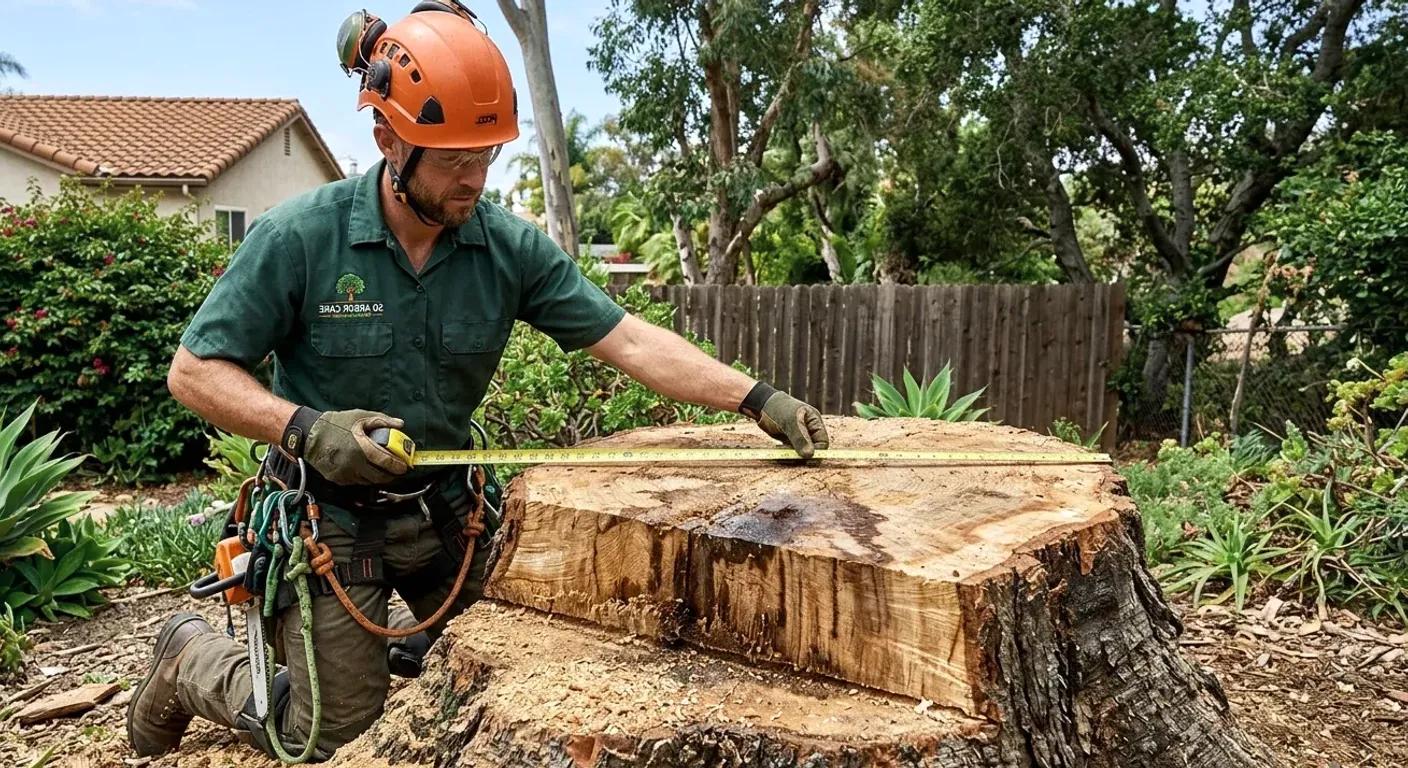
Ask the pro to explain their measurement method. Measuring the flat cut face gives one number. Measuring the widest part of the root flare at ground level gives another. Irregular cuts or wide flares make a single diameter hard to pin down. Multiple trunks from one base need separate measurements. Consistent measuring lets you compare proposals fairly. It stops one company from quoting the cut face while another includes the whole flare.
The agreed grinding depth
Your proposal should state exactly how deep the pro will grind. The right depth depends entirely on what happens next. Repairing a lawn requires less depth than pouring a walkway. Grinding wood does not prepare a site for concrete or foundations. Ask whoever manages your next project to define the required soil preparation. Grinding lowers the wood to a set level. It does not pull out the entire root network. Our stump grinding page explains what to gather before talking to a pro.
Surface roots inside the work area
Visible roots are not automatically included in the scope. Point out every root you want addressed and ask the pro to list them in writing. The plan should separate the main stump from roots running under lawns, fences, or irrigation lines. Sometimes a root must stay intact to protect a nearby tree you plan to keep. UC IPM warns that cutting established roots can cause delayed decline and instability. Excavation near a living tree requires its own assessment. Review UC IPM’s construction guidance for details on protecting trees during site work.
Equipment access across your property
The path to the stump dictates the method. Share these details with every pro you meet:
- Gate widths and tight passage points
- Slopes, stairs, and sharp turns
- Fences, pools, retaining walls, and raised beds
- Soft dirt or finished paving along the route
- Parking limits and staging space for machinery
Photos help, but they miss hidden constraints. The written proposal should name the planned route and note any surface protection.
Underground utilities and private lines
Heavy machinery should never start until underground conflicts are resolved. Irrigation pipes, pool wiring, septic parts, and private lighting often fail to show up on standard utility maps. DigAlert notes that member utilities usually mark only what they own and maintain, often stopping at the meter. Private lines require separate locating services. Paint marks also do not tell you how deep a line sits. Ask the pro who contacts DigAlert, who locates private lines, and what happens if a conflict appears. Never assume an unmarked yard is safe to grind.
Wood chips and site cleanup
Find out if the pro leaves the chips, spreads them, or hauls them away. Ask whether backfill, grading, seed, sod, or irrigation repair falls inside the scope. These are separate choices. Leaving a pile of wood chips is not the same as delivering a graded planting bed.
Comparing proposals side by side
Hold every written estimate against the same checklist.
| Written detail | What to check |
|---|---|
| Stumps covered | Total count, location, and measurement method |
| Root boundaries | Main stump only or specific surface roots included |
| Grinding depth | Agreed depth for each individual stump |
| Property access | Machinery route, staging area, and surface protection |
| Utility marking | DigAlert responsibility and private line locating |
| Debris plan | Chips left on site, spread out, or hauled away |
| Site finish | Backfill, grading, planting, or repairs included |
| Hidden obstacles | How buried metal, masonry, or unknown utilities change the plan |
A lower total often means a smaller scope. Compare the written work first, then look at the price.
Grinding, excavation, or leaving the stump
Grinding is not your only option. Your plans for the space should guide the choice. If you need heavy machinery for larger jobs, our pros handle tree removal as a separate scope.
Reducing the stump with a grinder
Grinding works when you just need the visible wood gone without pulling the whole root system. Confirm the depth, root boundaries, chip disposal, and final grade before approving the work.
Pulling the stump out completely
Excavation removes more wood and root mass. It also tears up significantly more soil. The plan must address utilities, irrigation, neighboring roots, machine access, and the hole left behind. Digging near a retained tree demands extra caution. Damaged roots can kill that tree months after the landscaping is finished.
Working around the existing stump
Leaving the stump avoids immediate digging. A landscape designer might route a path or planting bed around it. This choice still requires checking the wood’s condition, access needs, and future maintenance. Never pour concrete over a stump based solely on a grinding depth assumption.
Preparing the soil for grass or a new tree
Grass needs real topsoil, not a pit full of decaying wood chips. Iowa State University Extension recommends removing chips, sawdust, and root fragments before planting turf. Fill dirt, compaction, moisture, nutrients, and settling all need attention before laying seed or sod. Rotting wood leaves empty voids under the repaired lawn. Read their grass-after-stump-removal guidance for specifics.
Planting a replacement tree introduces different problems. Leftover roots, changed soil chemistry, and the old tree’s pest history affect the spot. Planting slightly off to the side avoids many issues inside the original root zone. Replanting in the exact same hole requires special preparation, as outlined by Iowa State University Extension.
Neither method prepares a site for a slab, foundation, or engineered structure. Give those architectural plans to your contractor before setting the stump scope.
Renting a machine versus hiring a pro
A daily rental rate covers a completely different scope than a professional proposal. Before comparing totals, define your gate width, slope, 811 locates, private irrigation, grinding depth, and chip disposal. Ask yourself who protects the private lines and finished paving, and who pays if something breaks. Limb SD does not rent equipment or set prices. Compare the rental plan and the professional scope against the same checklist above.
Chemical decay and open burning
Natural rot takes a long time. Iowa State University Extension separates commercial products meant to accelerate wood decay from herbicides used to stop sprouting. Those are two different goals. Product directions vary widely, so follow the current container label exactly instead of assuming one chemical does everything. Check their stump-removal guidance for more details.
Label language mentioning fire does not grant permission to burn a stump. The San Diego County Air Pollution Control District states that local fire authorities issue burn permits for specific locations, times, materials, and quantities. An approved air quality burn day does not override fire restrictions or local bans. San Miguel Fire & Rescue suspended permitted burning within its jurisdiction effective May 1, 2026.
Choose grinding when lowering the wood serves your next project. Choose excavation when you need the root mass and altered soil gone entirely. Consider redesigning around the stump when tearing up the yard creates bigger headaches. Our guide to removing a stump without grinding outlines questions to take to the appropriate professional.
How to request matching proposals
Send every pro the exact same information package.
- Photograph each stump from multiple angles.
- Show the full route the equipment must travel.
- Mark every visible root you want evaluated.
- Describe what you plan to do with the space afterward.
- List known irrigation lines and private utilities.
- Request the measurement method, depth, debris plan, and site finish in writing.
- Ask how they handle unexpected obstacles like buried concrete or rebar.
A detailed written scope makes exclusions obvious. It prevents you from paying for a landscaping finish another pro never promised. Before hiring anyone, verify their license status through the California Contractors State License Board lookup.
Common questions about stump pricing
Do pros always charge by the inch?
No single pricing rule applies everywhere. One company might charge per inch, per stump, or for the entire job. They weigh diameter alongside access difficulty, depth requirements, root spread, debris hauling, equipment size, and soil conditions. Ask how the pro measured your specific job and compare the full written scope.
Does the quote cover every surface root?
Not by default. The proposal must identify which roots fall inside the work boundary and where the grinding stops. Roots close to retained trees, utilities, hardscape, or structures might need a separate evaluation.
Can I pour a patio over a ground stump?
Grinding depth alone does not prepare a foundation. Hand your patio plans to the responsible contractor. Let that professional specify the excavation and soil prep required before you approve any stump work.
Will DigAlert mark my sprinkler lines?
Usually not. DigAlert states that member utilities mark only what they own and maintain. Private irrigation, landscape lighting, and drainage pipes require separate locating. Ask the pro who handles that task.
Is grinding bundled with tree cutting?
It depends on the paperwork. Treat tree felling, stump reduction, root work, debris hauling, and site restoration as separate line items unless the proposal clearly bundles them together.
When to call a tree professional
Call a pro when a remaining stump blocks new landscaping, poses a trip hazard, or interferes with planned construction. Heavy grinding machines require trained operators to avoid damaging underground utilities or nearby structures. Call (858) 400-4587 and Limb SD will connect you with a licensed local tree professional.