Limb SD connects property owners with licensed and insured independent tree professionals across San Diego County. You hire the pro directly and pay them for the work. We do not own equipment, hold trade licenses, or perform any tree services ourselves.
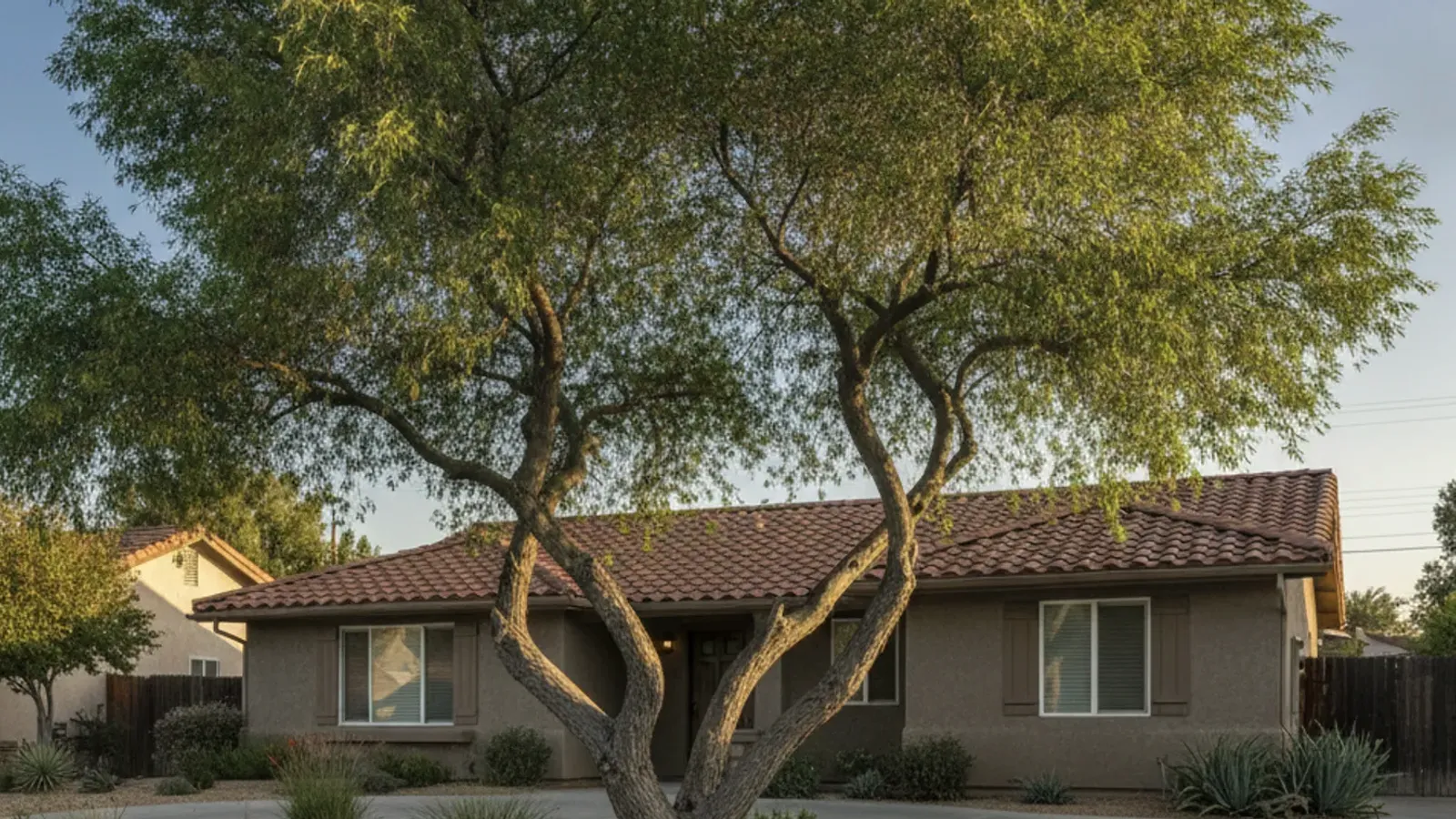
A Chilean mesquite tree can thrive in inland San Diego yards if its structure fits the site. The real questions involve branch stability, root conflicts with hardscape, and whether trimming or full removal makes sense.
Understanding the Chilean mesquite tree
The species carries two scientific names: Prosopis chilensis and Neltuma chilensis. Cal Poly’s SelecTree profile notes its South American origin, fine compound leaves, yellow spring blooms, and seed pods. Most specimens grow multiple trunks from the base. Hybridization happens easily, and while thornless versions exist, you cannot assume every tree lacks thorns.
Cal Poly describes the foliage habit as deciduous in some sections and semi-deciduous in others. Do not expect year-round greenery on every property. Check your specific tree for actual leaf drop patterns, thorn presence, and pod production before scheduling any work.
The SelecTree database places this species in a low water category. That trait explains its popularity in hotter inland areas like El Cajon, Santee, Lakeside, Poway, Escondido, and San Marcos. Evaluate your actual soil moisture, drainage patterns, and available space before keeping one near the coast or planting it inland. Cal Poly lists a mature canopy spread around 30 feet.
Expected size and growth speed
Maximum dimensions from Cal Poly reach 30 feet tall and 30 feet wide. Growth rates top out near 36 inches annually under ideal conditions. These numbers describe the species generally, not a guaranteed timeline for your specific lot.
Work with the tree standing in front of you. From ground level, observe where branches currently extend relative to roofs, fences, and pavement. Never use measuring tools near power lines or approach conductors to check clearance distances. Cal Poly does not rate this species as safe under utility wires. If limbs already cross into that airspace, stop immediately and follow the utility guidance below instead of attempting to cut toward live wires.
Our guide to identifying trees in San Diego helps distinguish this mesquite from other fine-leafed shade species common in the county.
Multi-trunk structure and wind safety
Growing several stems from one base is normal for this species. Multiple trunks alone never justify removal.
Stand on the ground and examine the joints where stems meet. Look for visible cracks, bark folding inward, rotting wood, suspended branches, sudden leaning, or shifting soil. Never climb the tree or probe near overhead wires to get a closer look. Note what sits directly beneath the canopy, such as a patio, driveway, play structure, or adjacent property line.
Branch strength earns a medium rating from Cal Poly. That classification does not guarantee failure during high winds, nor does it promise safety. Santa Ana gusts make inspecting known defects smart planning rather than proof an impending split will happen. Read more about seasonal preparation in our Santa Ana wind tree prep guide. Objective-based correction differs from routine thinning, which we explain in our structural pruning overview.
If any part of the tree contacts a downed wire, stay far away. Dial 911 and contact SDG&E at 1-800-411-7343. SDG&E controls whether the line can be de-energized, covered, or moved. For standing trees touching active lines, avoid ladders entirely and call the utility company first. Only authorized personnel handle vegetation near energized conductors.
Root behavior near concrete and plumbing
Cal Poly assigns a low potential for root damage to this species. Low potential still means roots interact with their surroundings, and it does not prove a particular tree caused existing pavement cracks.
When concrete heaves upward, photograph the base flare, the broken slab, and the distance separating them. Investigate poor drainage, soil settling, leaking irrigation valves, and recent trenching nearby. A matched professional can evaluate visible surface roots and overall stability. Sewer backups require camera inspections because exterior tree appearance reveals nothing about pipe interiors.
UC IPM warns that severing or crushing established roots often triggers delayed health decline. Damaging major structural roots also raises the chance of the entire tree falling during storms, particularly when soil stays saturated. Avoid ordering root cuts simply to level a raised sidewalk.
Always contact DigAlert before running powered digging equipment. Paint marks indicate member-owned utilities up to the meter, but they miss private lines and never confirm exact burial depth. Irrigation pipes, landscape lighting cables, and sewer laterals require separate locating efforts. Our piece on tree roots near sidewalks and sewer lines applies this same inspection logic to residential lots.
Installing root barriers
Barriers sometimes redirect new root growth, but success depends heavily on the installation. Gilman’s 2006 sidewalk-barrier research found outcomes depend on the material used, soil type, and drainage quality. Roots frequently grow back toward the surface. Older studies noted rapid return through poorly drained clay soils. That same trial showed no clear advantage for vertical barriers installed in well-drained ground.
Putting a barrier in the ground usually requires cutting through existing roots. Trenching guarantees neither tree survival nor permanent hardscape protection. Ask the professional exactly where they plan to dig, which roots face cutting, how utilities will be avoided, and how the paving gets repaired afterward.
Pruning objectives and timing
Every cut should serve a stated purpose. Clearing roof space, removing deadwood, addressing a cracked joint, and training young branches represent entirely different tasks.
ISA’s mature-tree brochure notes that older trees tolerate less foliage loss than younger ones. Random thinning without a goal fails to improve vigor. Stripping too many leaves drains stored energy reserves.
Never top this species. ISA’s topping guide explains how stub cuts stress the plant and force weakly attached regrowth. Reducing height by cutting back to appropriate lateral branches follows a completely different method. Our article on tree topping details why that distinction matters.
Timing depends on the tree’s current health, the stated goal, physical access, and active bird nests. A fractured union hanging above a walkway demands immediate attention regardless of the calendar month. CDFW recommends consulting a biologist when nesting activity is possible. Many birds nest between February and August, though activity occurs outside those months. Never move branches to peek inside a nest.
Climbing large specimens and operating chainsaws belong to trained crews. Review our tree trimming and tree pruning service pages to understand how scopes differ based on intended results.
Watering should match actual soil conditions rather than following a rigid calendar. Cal Poly’s low water category offers a general comparison, not an irrigation schedule. Letting the root zone dry out intentionally does not produce harder wood.
Choosing between management and removal
| Observation | Appropriate response |
|---|---|
| Solid branch unions with adequate surrounding space | Retain the tree and prune only for specific reasons. |
| Several trunks showing no decay, cracks, or targets | Examine the joints closely without assuming removal is necessary. |
| Splitting wood, suspended branches, or fresh leaning | Request a prompt risk evaluation from a matched professional. |
| Heaved pavement or suspected plumbing interference | Investigate drainage and pipes separately from tree roots. |
| Proposed barrier installation or major root cutting | Verify underground utilities, soil stability, and drainage impacts first. |
| Unresolvable conflict between the tree and the site | Compare removal scope against site restoration requirements. |
| Location within a public easement or right-of-way | Verify municipal or county jurisdiction before hiring anyone. |
When removal becomes necessary
Taking the tree out makes sense only after a qualified assessment identifies defects or conflicts beyond repair. Previous topping scars, recurring splits, or roots trapped inside unalterable infrastructure often point toward removal. Simply disliking the species never justifies taking it down.
A proper tree removal quote specifies which trunks are included, site access constraints, proximity to structures, debris hauling plans, stump grinding options, and final grading expectations. Taking down multiple stems in narrow side yards alters the required method significantly. Limb SD does not publish prices. The independent professional evaluates trunk count, equipment needs, crane requirements, permit costs, and hauling distance before quoting the job.
If you plan to replace it, weigh mature dimensions, water needs, thorn presence, litter volume, and utility clearances. Our drought-tolerant tree guide and the tipu tree profile offer useful comparisons, though neither serves as a direct substitute.
Permits and fire hazard regulations
Species identity alone never determines permit requirements. First, establish whether your parcel falls inside city limits or unincorporated county land. Next, determine if the tree stands on private property, public land, or within an easement. Parkway trees in El Cajon fall under city maintenance jurisdiction. Unincorporated communities like Lakeside route questions through County PDS. Our post on San Diego city tree removal permits covers municipal rules further.
Properties located within mapped fire-hazard zones must follow current vegetation rules set by the local fire authority. Ask specifically about requirements for the first five feet surrounding structures. Never assume a mesquite automatically qualifies for defensible-space clearing. Parcel boundaries and protected easements still restrict how much vegetation you can legally remove.
Frequently asked questions
Does this species create yard litter?
Leaflets, spring flowers, and seed pods all drop throughout the year. Cleanup effort depends on what hangs directly above hardscape. Debris landing in a pool or on a patio demands more attention than material falling into open mulch beds.
Will I encounter thorns on my tree?
Thornless cultivars exist, but the species as a whole produces thorns. Inspect lower branches, trunk sprouts, and fresh growth before working underneath the canopy.
What irrigation schedule keeps it healthy?
The low water designation provides a general baseline rather than a strict weekly volume. Test soil moisture at depth, verify drainage speed, and adjust competing sprinkler heads accordingly.
How much clearance does it need from structures?
Compare the 30-foot maximum canopy width from Cal Poly against your actual root flare location, existing paving, buried utilities, and available lot space.
Which month works best for trimming?
Schedule cuts when the objective, tree health, physical access, and nesting status align. Dangerous defects over pedestrian paths require immediate evaluation regardless of season. Our tree pruning calendar breaks down seasonal considerations for the region.
What drives the cost of trimming or removal?
The matched professional bases quotes on trunk count, overall size, site access difficulty, proximity to hazards, debris hauling distance, stump grinding needs, and required permits. Limb SD does not set or negotiate these figures.
When to call a tree professional
Contact a pro when branches threaten structures, roots lift concrete, or storm damage compromises the trunk. Attempting large-scale trimming or removal without training risks severe injury and property damage. Call (858) 400-4587 and Limb SD will connect you with a licensed local tree professional.